
Choosing the Right MTD Software: An Honest Guide for UK Sole Traders in 2026
Choosing MTD-compatible software in 2026? An honest comparison of FreeAgent, Xero Simple, Xero Ignite, QuickBooks Sole Trader, Sage Individual, Coconut and Starling for UK sole traders. No affiliate links, just practical advice.
MAKING TAX DIGITAL FOR INCOME TAX
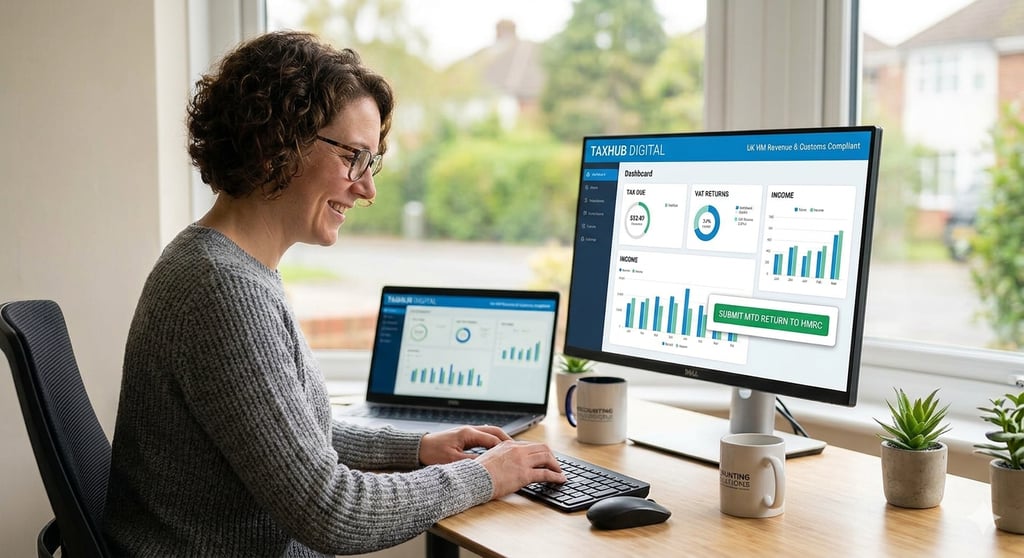
If you have to use MTD-compatible software now or in the next twelve months, the obvious next question is which one?
Search for an answer and you will find dozens of articles. This post narrows them down for you and discusses the top ones to consider, especially if you don't have or have never used an accountant.
What MTD Softwares Actually Have to Do.
Before we get to the options, it is worth being clear about what the software is required to do for you. Anything beyond that is a nice-to-have, not a need.
For MTD compliance specifically:
the software must keep digital records of your income and expenses.
It must connect to HMRC and submit your quarterly updates.
It must handle your final declaration at the end of the tax year. That is the minimum.
Most of the platforms below also offer bank feeds that pull transactions in automatically, handle invoicing, capture expenses from receipts, track mileage, and provide tax estimates. These features make the software pleasant to use day to day but they are not required for MTD compliance.
The platforms below are all on HMRC's approved list of MTD for Income Tax. None of them will get you in trouble for compliance. The differences are in price, ease of use and how well each fits the particular type of sole trader.
a) Free Agent.
Price. Free if you have a NatWest, RBS, Mettle or Ulster Bank business account, £19 per month otherwise.
Best for. Most sole traders, especially freelancers, consultants and contractors with straightforward income.
Free Agent is genuinely free if you bank with NatWest, RBS, Mettle or Ulster Bank. NatWest Group acquired Free Agent and now offers it as a free benefit to business banking customers, including the entire premium feature set and there is no catch. There is no limited tier. You get the same product as someone paying £19 per month directly to FreeAgent.
For anyone in that banking position, the choice is essentially made. Free Agent is fully MTD-compliant for both VAT and Income Tax, the interface is built for non-accountants, and it handles Self Assessment filing inside the same platform. There is almost no scenario where paying for different software makes sense when you can have a full-featured product at no cost.
The interface is clean and tax-led, which means the language and workflow assume you are a UK sole trader rather than a small American business. Mileage tracking is built in, the tax forecasting is genuinely useful. Many UK accountants are familiar with it.
The downsides are few. The third-party app library is smaller than Xero's, which only matters if you rely on niche integrations.
Property income features are less developed than the platforms designed with landlords specifically in mind. And if your business grows substantially or becomes a limited company, you may eventually outgrow it.
If you bank elsewhere, the £19 per month makes Free Agent harder to justify against alternatives. But for the majority of UK sole traders who happen to bank with the NatWest group, this is the answer.
b) Xero Simple (For Non-VAT Registered Sole Traders).
Price. £7 per month plus VAT.
Best for. Sole traders on a budget who want the cheapest entry point from a major UK provider.
Xero Simple is a relatively new plan, launched in April 2025 specifically for sole traders and landlords entering MTD.
It is the cheapest paid route to full MTD for Income Tax compliance from any of the big providers and is built for individuals with straightforward financial affairs.
For £7 plus VAT per month you get MTD for Income Tax filing within the platform, bank feeds, receipt capture through Hubdoc, and basic invoicing. Quarterly updates and the Final Declaration are submitted directly to HMRC from within Xero with no bridging software or separate portal needed.
The trade-off is the deliberately limited feature set. Xero Simple is not designed for businesses that need extensive invoicing, multi-user access, advanced reporting, international features or are VAT registered. If your business outgrows it, Xero offers a clear upgrade path to higher tiers without changing platforms or migrating data.
For a sole trader with simple income, no employees, no complex invoicing needs and no plans to scale significantly, Xero Simple is genuinely the most cost-effective major-provider option in 2026.
c) Xero Ignite (For Non-VAT Registered Sole Traders).
Price. £16 per month plus VAT.
Best for. Sole traders who work with an accountant, those expecting to grow significantly, and anyone with multi-currency income.
Xero Ignite is the next tier up from Xero Simple and is the right choice for sole traders whose business is more complex than the entry-level plan handles well. It includes everything in Xero Simple plus better invoicing, more comprehensive reporting, and the broader Xero ecosystem.
Xero is the most widely used accounting platform among UK accountants, which matters more than people realise. If you have an accountant or plan to get one, working in the same system saves time and money. Inefficient software adds hours to your accountant's year-end work, and if they charge by the hour, that costs you.
Xero's strengths are its bank reconciliation speed, the breadth of its third-party app integrations, and how well it handles complexity when your business grows. Multi-currency, multiple income streams, planned incorporation, hiring staff later, raising investment; these are all situations where the broader ecosystem becomes genuinely useful.
The £16 per month is not ruinous but it is £192 per year for something a NatWest, RBS or Mettle customer can have free. For a sole trader with simple income, Xero Simple at £7 covers everything they need. For a consultant with international clients and ambitions to scale, Ignite is the right foundation.
d) QuickBooks Sole Trader.
Price. £10 per month for the Sole Trader plan. Higher tiers from £14 per month.
Best for. Sole traders who want a strong mobile-first experience, particularly tradespeople and those who track mileage frequently.
QuickBooks Sole Trader is purpose-built for self-employed individuals. The plan is deliberately simple. It does income and expense tracking, mileage capture, MTD submissions and Self Assessment filing in one place.
The mobile app is genuinely good. If you spend most of your working day away from a desk, taking photos of receipts on your phone and tracking mileage automatically through GPS is a real time saver. For tradespeople, mobile-first sole traders, and anyone who wants admin to feel quick rather than formal, QuickBooks works well.
There are downsides worth flagging. QuickBooks raised UK prices significantly in January 2026, with some plans going up by 50 percent. While the Sole Trader plan stayed competitive, the upgrade path becomes expensive quickly if you need any of the higher tier features.
The interface has American roots and some workflows feel designed for the US market first and QuickBooks' frequent promotional pricing means the £10 you sign up at often becomes £20 after six months.
If your priority is the cheapest possible price from a major provider, Xero Simple at £7 is now cheaper. QuickBooks Sole Trader is the better choice if mobile-first workflow and mileage tracking are particularly important to you.
e) Sage Individual.
Price. Free tier available with limited features. Paid plans from around £12 per month.
Best for. Sole traders who are already familiar with Sage products or have an accountant who uses Sage.
Sage launched its Individual tier specifically for sole traders facing MTD, with a free version that covers the basics for very simple sole traders submitting fewer than five invoices per month.
The paid version is comparable to QuickBooks Sole Trader on price and features.
Sage's strength is its long history with traditional UK businesses. If you have used desktop Sage products in the past or have an accountant who works in Sage, the familiarity matters. The downside is that Sage is less commonly used by new sole traders compared to FreeAgent, Xero or QuickBooks, and the interface feels more dated to anyone coming from a more modern platform.
For most new sole traders entering MTD, Sage is not the obvious first choice. For those already in the Sage ecosystem, it is a sensible continuation rather than a switch.
f) Coconut.
Price. Around £6 per month for the basic plan. Higher tiers up to £15 per month.
Best for. Sole traders who want a simple, UK-built tool focused on tax rather than accounting.
Coconut is purpose-built for UK sole traders and self-employed individuals. It is not full accounting software in the way Xero or QuickBooks are. It is tax-focused, mobile-led, and designed to make MTD submissions and Self Assessment as simple as possible.
The strength is the focus. If all you need is income and expense tracking that submits to HMRC quarterly, Coconut does that without overwhelming you with features for a business you do not run.
The mobile app is genuinely good and bank feed support covers most major UK banks.
The trade-off is feature depth. If your business grows or becomes more complex, Coconut may not scale with you. There is no multi-currency support, limited invoicing features, and the integration ecosystem is small.
For a side hustle approaching the MTD threshold or a sole trader who wants the simplest possible compliant tool, Coconut is worth considering.
For anything more complex, the bigger platforms are a better fit.
g) Starling Bank Option.
Price. Free with a Starling business account. Includes basic bookkeeping and MTD-compatible record keeping.
Best for. Existing Starling business banking customers with very simple sole trader income.
Starling has built basic MTD-ready bookkeeping into its sole trader business account at no additional cost. This is a recent addition and the feature set is limited compared to the dedicated accounting platforms above, but for someone who only needs to track income and expenses and submit quarterly updates, it does the job.
This is worth knowing about specifically because Starling business accounts are popular with new sole traders. If you already use Starling, check what is available before paying for separate software.
The functionality is more basic than Free Agent, Xero or QuickBooks but for a simple sole trader it may be enough.
How to Decide in 5 Minutes.
Forget all the comparison content for a moment. Here is the practical decision tree.
If you bank with NatWest, RBS, Mettle or Ulster Bank. Use FreeAgent. It is free, it is fully MTD-compliant, and you would have to find a very specific reason to choose anything else.
If you bank with Starling. Look at what is included with your account first. If it is enough for your simple sole trader needs, use it.
If you need more features, look at Xero Simple at £7 or QuickBooks Sole Trader at £10.
If you have or want an accountant. Ask them which platform they use before you choose. Most UK accountants prefer Xero, where the entry point for sole traders is now Xero Simple at £7. Some prefer QuickBooks. A few still use Sage.
Working in the same system as your accountant saves them time at year end and costs you less in fees.
If you are on a tight budget and bank with a bank that does not include FreeAgent. Xero Simple at £7 per month plus VAT is the cheapest realistic option for full MTD coverage from a major provider in 2026.
If mobile-first workflow is your priority. QuickBooks Sole Trader at £10 has the strongest mobile app in this space, particularly for tradespeople and anyone who tracks mileage frequently.
If you have or expect to have complex income. Multiple income streams, international clients, planned incorporation, employees in the future, Xero Ignite at £16 is the platform that scales without forcing you to migrate later.
If you have a side hustle just approaching £50,000. Coconut at £6 per month is the simplest entry point. You can always upgrade later.
What to Watch Out For.
A few things worth being aware of regardless of which platform you choose.
Promotional pricing always expires. Almost every paid platform offers a 50% discount for the first three or six months. When the discount ends, the real cost is what you should have been comparing.
The cheapest plan does not always include MTD for Income Tax. Some platforms reserve MTD ITSA support for higher tiers. Always confirm specifically that MTD for Income Tax is included, not just MTD for VAT.
Bank feed coverage matters. The whole point of MTD-ready software is that transactions flow in automatically. If your bank is not well supported, the software becomes manual data entry, which defeats the purpose. Check bank feed support for your specific bank before committing.
Spreadsheets alone do not meet the MTD requirement. If you want to keep using a spreadsheet, you need bridging software like VitalTax (£30 per year) that connects the spreadsheet to HMRC. This is the cheapest route to compliance for anyone who is genuinely committed to spreadsheets, but it requires careful record-keeping discipline.
Switching is possible but painful. The cleanest time to switch platforms is at the start of a tax year on 6 April, with a quarter boundary as the next-best option.
Mid-year switches are doable but mean reconciling data across two systems for the period in question.
The Conclusion.
There is no single best MTD software for UK sole traders. There is a best one for your specific situation.
For most sole traders in the NatWest banking group, FreeAgent is the answer. For most other sole traders on a budget, Xero Simple at £7 plus VAT. For sole traders with strong mobile-first workflow needs, QuickBooks Sole Trader. For sole traders with accountants or growth ambitions, Xero Ignite. For very simple sole traders who only need MTD compliance and nothing else, Coconut or Starling.
The choice matters less than the habit. The best software in the world will not save someone who only opens it once a quarter under deadline pressure.
The cheapest and simplest software will work brilliantly for someone who keeps their records updated weekly and treats the quarterly submission as a five-minute review rather than a reconstruction.
If you are still pre-MTD and below the £50,000 threshold, you do not need any of this yet.
The UK Sole Trader Tax Template gives you the income and expense tracking, the tax calculation and the visibility into your January position without the monthly subscription. When MTD eventually applies to you, the records you have built up using the template migrate cleanly into whichever platform you choose. The habits you build using it are exactly the habits MTD will require of you.
Get the UK Sole Trader Tax Template, £9.99 →
If you are about to enter MTD or are already inside it and want help choosing the right software for your specific situation, a Done With You session will give you a clear answer based on your actual numbers, your bank, your accountant relationship and your growth plans.
Book a Done With You session →
Blog content is for information purposes only and over time may become outdated as the tax landscape is constantly changing, although we do strive to keep it current and up to date. It is written to help you understand your taxes and is not to be relied upon as professional accounting, tax and legal advice. For additional help please contact a professional adviser.
Bookkeeping
Email:
Contact Us
support@rhodiumaccounting.co.uk
Monthly Management Reporting
Budgets & Forecasts
Cash flow Optimisation
Processes and Controls
Other Services

