
Companies House Identity Verification: What UK Directors Must Do To Avoid Penalties.
From November 2025, UK company directors and PSC must complete mandatory identity verification. These new rules aim to tackle fraud but also introduce important compliance requirements. This guide explains what the changes mean and how to stay compliant.
RUNNING A BUSINESS
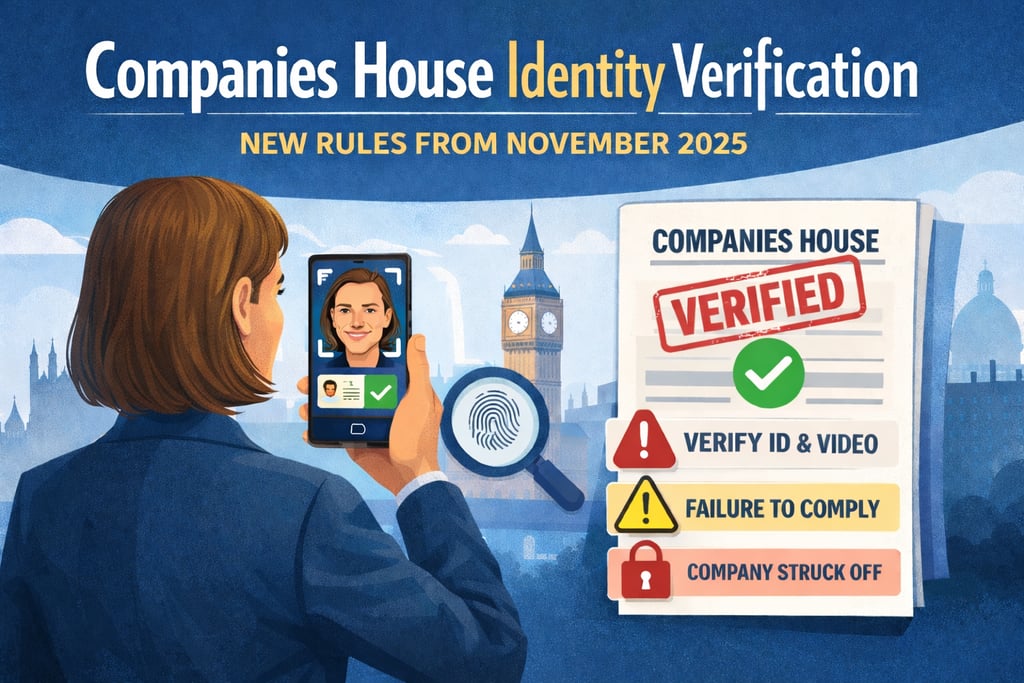
If you run a limited company in the UK, there’s an important change coming that you cannot afford to ignore.
From 18 November 2025, every company director and person with significant control (PSC) will be required to complete Companies House identity verification. This new rule forms part of the Economic Crime and Corporate Transparency Act 2023, a major reform designed to reduce fraud and improve transparency across UK businesses.
At first glance it might sound like just another administrative task. But in reality, it represents one of the biggest changes to Companies House in decades.
Directors who fail to complete identity verification could find their companies marked as non-compliant, prevented from filing documents, or in extreme cases even struck off the Companies House register entirely.
So what exactly is changing? Why are these rules being introduced? And what do you need to do to make sure your company stays compliant?
Let’s break it down.
Why Companies House Is Introducing Identity Verification
For many years, the UK has had one of the easiest company registration systems in the world.
Starting a company could be done online in minutes, often with minimal verification of the people involved. This accessibility helped entrepreneurs launch businesses quickly, which was great for economic growth.
However, the system also had a downside.
It made it possible for individuals to create companies using false identities or inaccurate information. In some cases, companies were used for fraudulent activities such as:
Money laundering
Tax evasion
Creating fake directorships
“Phoenix” companies that repeatedly dissolve and restart to avoid debts
In response to these concerns, the UK government introduced the Economic Crime and Corporate Transparency Act.
This legislation gives Companies House significantly more powers than it previously had.
Instead of acting purely as a registry that records company information, Companies House will now also play a stronger role in verifying and policing the accuracy of that information.
Identity verification is one of the most significant parts of that reform.
The aim is simple: to ensure that the people running UK companies are real individuals whose identities have been verified.
Who Needs to Complete Companies House Identity Verification?
The new verification rules apply to several key roles within UK companies.
You will need to verify your identity if you are:
A company director
A person with significant control (PSC)
Someone submitting filings on behalf of a company
An authorised corporate service provider such as an accountant or company formation agent
For those unfamiliar with the term, a person with significant control is someone who:
Owns more than 25% of a company’s shares, or
Holds more than 25% of the voting rights, or
Has the ability to significantly influence or control the company
Importantly, the rules apply to both new companies and existing companies.
That means even if you have been running your company for years, you will still need to complete the verification process.
How Companies House Identity Verification Works
The identity verification process itself is designed to be quick and straightforward.
Most directors will complete it using the GOV.UK identity verification system, which forms part of the government’s One Login service.
The process generally involves three steps.
Step 1: Provide an Identification Document
You will need to upload or scan a valid identification document. In most cases this will be either:
A passport
A UK driving licence
The system uses this document to confirm your legal identity.
Step 2: Complete a Facial Recognition Check
You will then be asked to take a selfie using your phone.
This allows the system to compare your face with the photograph on your identification document using facial recognition technology.
This step confirms that the person submitting the verification is the same person shown on the ID.
Step 3: Confirm Personal Information
You will also be asked to confirm details such as:
Your date of birth
Your residential address
Once everything has been verified, Companies House will issue a personal verification code.
This code links your verified identity to the companies you are connected with.
You may need to use this code when submitting future filings or updating company information.
For that reason, it’s important to store it somewhere secure but accessible.
Verifying Your Identity Through an Accountant
Some directors may prefer not to complete the verification themselves.
Instead, they can verify their identity through an Authorised Corporate Service Provider (ACSP).
This could include:
Accountants
Company formation agents
Professional service providers registered with Companies House
These agents carry out identity checks and confirm the verification to Companies House on your behalf.
For many business owners, this can be the easiest option, especially if their accountant already manages company filings.
However, there may be a small fee for this service depending on the provider.
What Happens If You Do Not Verify Your Identity?
One of the reasons these changes are attracting so much attention is the potential consequences of ignoring them.
Under the new legislation, Companies House now has significantly stronger enforcement powers.
If a director or PSC fails to verify their identity, Companies House may take actions such as:
Refusing to accept company filings
Flagging the company as non-compliant
Preventing new directors from being appointed
Initiating the process of striking the company off the register
For business owners, the most serious consequence is company strike-off. When a company is struck off, it legally ceases to exist.
That means it can no longer trade, enter contracts, or operate as a legal entity.
How Companies Get Struck Off Without Directors Realising
Many directors assume that if their company were about to be struck off, they would definitely know about it.
In practice, that is not always the case.
Strike-offs often occur because of simple administrative issues such as:
Missing a confirmation statement
Forgetting to file accounts
Not updating the registered office address
Ignoring Companies House letters
If Companies House cannot contact a company at its registered address, it may assume the company is no longer active. The strike-off process can then begin automatically.
This happens more frequently than many people realise.
What Happens to Company Assets After Strike-Off?
One of the biggest risks associated with company strike-off is what happens to company assets.
When a company is dissolved while still holding assets, those assets do not automatically transfer to the directors or shareholders.
Instead, they pass to the Crown under a legal principle called bona vacantia.
This can include:
Cash held in company bank accounts
Property owned by the company
Vehicles
Intellectual property
Equipment or inventory
Recovering those assets later can be extremely difficult and often involves court applications.
For that reason, preventing strike-off in the first place is always the safest approach.
Companies House Fees Are Increasing
Another change business owners should be aware of is the increase in Companies House fees.
From February 2026, several fees will increase as part of the reforms.
For example:
Company incorporation will increase from £50 to £100
The annual confirmation statement will increase from £34 to £50
These increases are intended to help fund the expanded role of Companies House under the Economic Crime and Corporate Transparency Act.
While the increases may appear modest, they represent another compliance cost for small businesses.
The Growing Compliance Burden on Small Businesses
Small business owners already face a long list of responsibilities.
Running a limited company involves:
Filing annual accounts
Submitting confirmation statements
Paying corporation tax
Maintaining accurate records
Complying with tax and regulatory requirements
Adding mandatory identity verification and higher Companies House fees means another task on that list.
Large corporations often have compliance departments to manage these obligations. Small businesses and solo directors often handle them personally.
That’s why staying organised and informed is essential.
Practical Steps To Take Now if you are a Company Director or PSC
If you run a limited company, there are several simple steps you can take to prepare for these changes.
Verify Your Identity Early
Completing identity verification only takes a few minutes. Doing it early avoids last-minute stress or compliance issues.
Check Your Registered Office Address
Ensure that the registered address on Companies House records is correct and regularly monitored.
Important notices are sent there.
Review Your Company Details
Make sure the following information is accurate:
Directors
Persons with significant control
Company contact details
Filing dates
Incorrect information can create unnecessary problems.
Work With a Professional Advisor
If you are unsure about the process, an accountant can help ensure your company remains fully compliant.
Final Thoughts
The introduction of Companies House identity verification represents one of the most significant changes to UK company regulation in many years.
While the reforms are designed to prevent fraud and improve transparency, they also introduce new compliance requirements for millions of legitimate business owners. The good news is that the process itself is relatively simple.
By verifying your identity, keeping your company records accurate, and staying on top of filings, you can ensure your company continues to operate smoothly.
In most cases, taking just a few minutes now can prevent far bigger problems later.
Blog content is for information purposes only and over time may become outdated as the tax landscape is constantly changing, although we do strive to keep it current and up to date. It is written to help you understand your taxes and is not to be relied upon as professional accounting, tax and legal advice. For additional help please contact a professional adviser.
Bookkeeping
Email:
Contact Us
crystal@rhodiumaccounting.co.uk
© 2026. All rights reserved | Privacy Policy | Terms and Conditions
Monthly Management Reporting
Budgets & Forecasts
Cash flow Optimisation
Processes and Controls
Other Services

