
Director Profit Extraction: The 7 Biggest Mistakes to Avoid
Limited company director profit extraction. This article explains the seven biggest mistakes to avoid and turn your company into a successful financial engine.
DIVIDENDS

If you ask most limited company directors how they pay themselves, the answer is usually quick and confident.
“A small salary and the rest in dividends.”
That approach worked well for years. It was simple, predictable, and generally tax efficient. But in 2026, simplicity is quietly becoming expensive.
Rising employer National Insurance, shrinking dividend allowances, higher dividend tax rates and frozen thresholds mean the old default method is no longer automatically smart. And yet many directors are still operating on autopilot.
The problem is not that directors do not have options. It is that they misunderstand how those options are meant to work together.
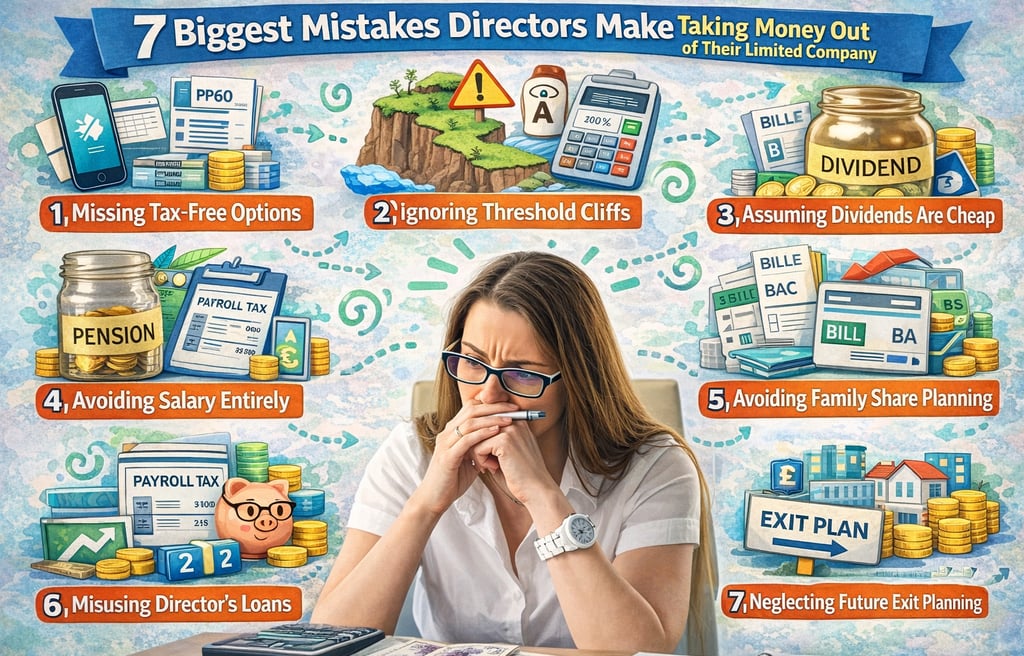
Here are the seven biggest mistakes directors make when taking money out of their limited company, and why they cost far more than people realise.
Mistake 1: Thinking Salary and Dividends Are the Whole Strategy
This is by far the most common error.
Many directors believe tax planning starts and ends with choosing the right salary and dividend mix. They spend hours debating whether their salary should be just below the National Insurance threshold or slightly higher to maintain state pension eligibility.
Meanwhile, they are personally paying for mobile phones, training, subscriptions, insurance and home office costs out of taxed income.
That is backwards.
The most efficient extraction strategy often begins by reducing how much income you need to extract at all. If your company legitimately pays for costs, you are already incurring, that is tax free value. You are not extracting more. You are extracting smarter.
When directors skip this first layer and jump straight to dividends, they are effectively choosing to pay tax unnecessarily. The obvious strategies are not always the most powerful ones. The quiet, unglamorous allowances usually move the needle more than people expect.
Mistake 2: Ignoring Threshold Cliffs
Most directors focus on tax rates. Very few focus on thresholds.
But modern UK tax is built around cliffs. Cross a line by one pound and you can trigger disproportionate consequences.
Go slightly over £100,000 in adjusted net income and you start losing your personal allowance. That creates an effective 60 percent tax band. If you have children and use the tax-free childcare scheme, you lose eligibility entirely at that same £100,000 level. One badly timed dividend can wipe out thousands in support.
Even smaller thresholds matter. Go one pound over the 150 per head annual staff event limit and the entire event becomes taxable, not just the excess.
Sophisticated tax planning is not about chasing the lowest rate. It is about carefully managing income so you never fall off a cliff edge unintentionally.
Mistake 3: Treating Dividends as Automatically Cheap
Dividends used to feel like a gift. No National Insurance. Lower tax rates than salary. Easy.
That era is over.
Dividend allowances have been reduced to almost nothing. Basic and higher rate dividend taxes are no longer trivial. When combined with corporation tax, the effective total burden is often higher than directors assume.
Dividends are still useful. They are still important. But they are no longer lazy tax planning.
Dividends now need sequencing. They need threshold management. They need to be stacked with salary planning, pension contributions and share structure decisions.
Directors who still rely on dividends as the backbone of their strategy without layering other allowances around them are often paying more than they realise.
Mistake 4: Avoiding Salary Because It “Feels Expensive”
Some directors avoid salary almost entirely because employer National Insurance has increased. They see the headline rate and decide salary is inefficient.
But that ignores two things.
First, salary is a deductible expense. It reduces corporation tax. That softens the blow immediately.
Second, many directors are eligible for the employment allowance if they employ at least one non director employee or have multiple directors. That can offset employer National Insurance completely.
In the right circumstances, salary becomes strategic rather than expensive. It supports mortgage applications. It builds state pension years. It creates stability for lenders. And it interacts with other allowances in ways dividends cannot.
Rejecting salary outright because of National Insurance is often an oversimplification.
Mistake 5: Failing to Structure Share Ownership Properly
This is where the real money is often saved.
Many directors operate as sole shareholders even when they have a spouse or civil partner who could legitimately own shares. That means only one personal allowance, one dividend allowance, one set of tax bands and one capital gains tax allowance are being used.
When ownership is structured properly, income can be split across households. That alone can transform the total tax bill.
Alphabet shares take this further by allowing flexible dividend payments to different shareholders. When implemented correctly and for commercial reasons, they offer enormous flexibility.
Ownership structure is not a minor administrative detail. It is the foundation of household tax efficiency. Directors who treat it casually often overpay for years.
Mistake 6: Using Director’s Loans as a Lifestyle Tool
Director’s loan accounts are useful. They are also dangerous when misunderstood.
If the company owes you money, repayments are tax free. That is simple.
If you borrow from the company, you can take up to £10,000 short term without triggering a benefit in kind. That can be helpful for timing purposes.
But if loans are not repaid within nine months of the year end, the company can face a Section 455 charge. That is not a small inconvenience. It is HMRC’s way of discouraging directors from using their company as a personal bank.
The subtle point here is that director’s loans are timing tools. They smooth cash flow. They bridge gaps. They allow better sequencing of dividends.
They are not a substitute for income planning. Directors who rely on them casually often end up creating unnecessary admin and stress.
Mistake 7: Leaving Exit and Inheritance Planning Too Late
The biggest tax savings in a business journey often happen at the end, not during the annual extraction phase.
Business Asset Disposal Relief, Members’ Voluntary Liquidations and capital distributions can result in significantly lower tax rates compared to taking everything as dividends. But these only work when conditions are met well in advance.
Similarly, Business Relief for inheritance tax can eliminate a potentially devastating tax bill for your family if you hold qualifying trading company shares for the required period. However, accumulating excessive investment assets or cash inside the company can jeopardise that relief.
Exit planning and inheritance planning are not last-minute exercises. They are structural decisions made years before you need them.
Directors who treat tax planning as an annual compliance task often miss the larger strategic picture. The real risk is not paying slightly too much tax this year. It is failing to design the business properly for the long term.
The Bigger Pattern
When you step back, a theme emerges.
Most directors think tax planning is about extracting money cheaply.
In reality, it is about business design. It is the intentional structuring of your company so that tax efficiency, cash flow, protection, and long-term outcomes are built into it from the start.
It is about sequencing income carefully. It is about structuring ownership intentionally. It is about managing thresholds with precision. It is about smoothing cash flow responsibly. It is about protecting family wealth. And sometimes it is about not extracting money at all if reinvesting produces a better long-term outcome.
The directors who consistently pay less tax are not aggressive. They are structured.
They use the free layers first. They understand cliff edges. They stack strategies. They plan exits early. They think in years, not months.
If you recognise yourself in one of these mistakes, that is not a failure. It is an opportunity.
Because once you see the structure behind the system, you stop reacting to tax. You start designing around it.
And that is where the real savings begin.
Blog content is for information purposes only and over time may become outdated as the tax landscape is constantly changing, although we do strive to keep it current and up to date. It is written to help you understand your taxes and is not to be relied upon as professional accounting, tax and legal advice. For additional help please contact a professional adviser.
Bookkeeping
Email:
Contact Us
support@rhodiumaccounting.co.uk
Monthly Management Reporting
Budgets & Forecasts
Cash flow Optimisation
Processes and Controls
Other Services

