Group Personal Pension Plan vs Stakeholder Pensions: Key Differences.
Group Personal Pensions vs Stakeholder Pensions: What’s the Difference and What Works Best if You are Self-Employed?
PENSIONS
When it comes to pensions, the terminology can feel unnecessarily complicated. Group Personal Pensions, stakeholder pensions, SIPPs, they’re all personal pensions, yet they are designed for very different situations. Let’s break it down in plain English.
What is a Group Personal Pension?
A Group Personal Pension (GPP) is a type of workplace pension set up by an employer for their employees. While each member has their own individual personal pension policy, the scheme itself is arranged and selected by the employer.
You can only join a GPP if:
You are currently employed by the organisation that set it up, or
You were employed by them in the past and still hold the pension contract.
This is an important point: a GPP is not something you can just go out and buy for yourself. Without an employer arranging the scheme, it simply is not available to individuals. Employers often use GPPs to meet their auto-enrolment obligations, and they may also negotiate lower charges or a wider investment range for staff.
So, what do self-employed people use instead?
If you are self-employed and are not locked out of pension saving you just use a different route. The most common options are:
Personal or Stakeholder Pensions
These can be opened directly by individuals, including the self-employed. You pay in what you can, when you can, and benefit from tax relief (20% added automatically, with higher or additional rate relief claimed through Self-Assessment). Many providers allow you to join without any employer involvement at all.
Self-Invested Personal Pensions (SIPPs)
A SIPP is also a personal pension, but with far greater investment freedom. You choose where your money is invested and can vary contributions as your income changes. This flexibility is why SIPPs are especially popular with self-employed people.
GPPs vs Stakeholder Pensions: how do they compare?
While both are personal pensions, they are designed with different priorities in mind.
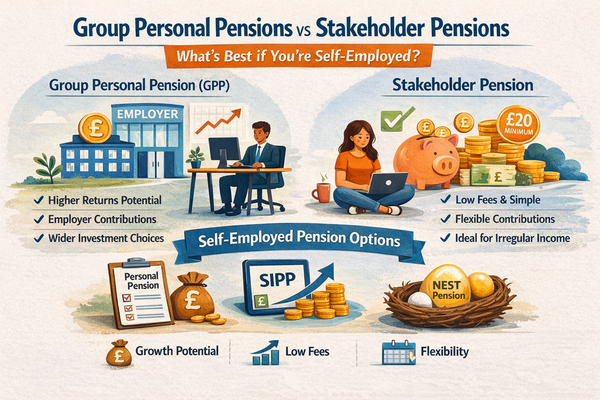
Group Personal Pensions (GPPs)
GPPs generally have the potential to deliver higher long-term returns. That is mainly because they tend to offer:
A wider range of investment funds
Access to higher-risk, higher-growth strategies
Lower charges negotiated by employers, often around 0.5%–0.75%
They are best suited to people who are comfortable taking some investment risk in exchange for potentially higher growth.
Stakeholder Pensions
Stakeholder pensions are deliberately simple and tightly regulated. They focus on accessibility rather than sophistication:
Charges are capped by the government (1.5% for the first 10 years, then 1%)
Investment choices are usually low-to-medium risk
Minimum contributions are very low (often £20 or less)
Payments can be stopped and started without penalties
Because of this, stakeholder pensions are often better suited to lower earners, people with irregular income, or those new to investing, including many self-employed individuals.
Key things to think about
Employer contributions matter: If you have access to a workplace pension whether it is a GPP or a stakeholder scheme it is usually the best place to start, because employer contributions are effectively free money.
Charges vs growth: While stakeholder pensions have capped fees, some modern GPPs and SIPPs are actually cheaper and offer better investment options.
Flexibility is crucial: If your income goes up and down, the ability to pause or vary contributions (a big strength of stakeholder pensions and SIPPs) can be more valuable than chasing higher returns
The bottom line
Group Personal Pensions can be excellent, but they are tied to employment. If you are self-employed, a stakeholder pension or SIPP will usually give you the control and flexibility you need and the right choice depends less on labels and more on your income pattern, confidence with investing, and long-term goals.
Blog content is for information purposes only and over time may become outdated as the tax landscape is constantly changing, although we do strive to keep it current and up to date. It is written to help you understand your taxes and is not to be relied upon as professional accounting, tax and legal advice.
Bookkeeping
Email:
Contact Us
support@rhodiumaccounting.co.uk
Monthly Management Reporting
Budgets & Forecasts
Cash flow Optimisation
Processes and Controls
Other Services

