
How to Appeal an HMRC Penalty and Actually Win.
Received an HMRC Self Assessment penalty? Here is what counts as a reasonable excuse, how to write an appeal that works, and what to do if HMRC says no.
SELF ASSESSMENT TAX RETURNS
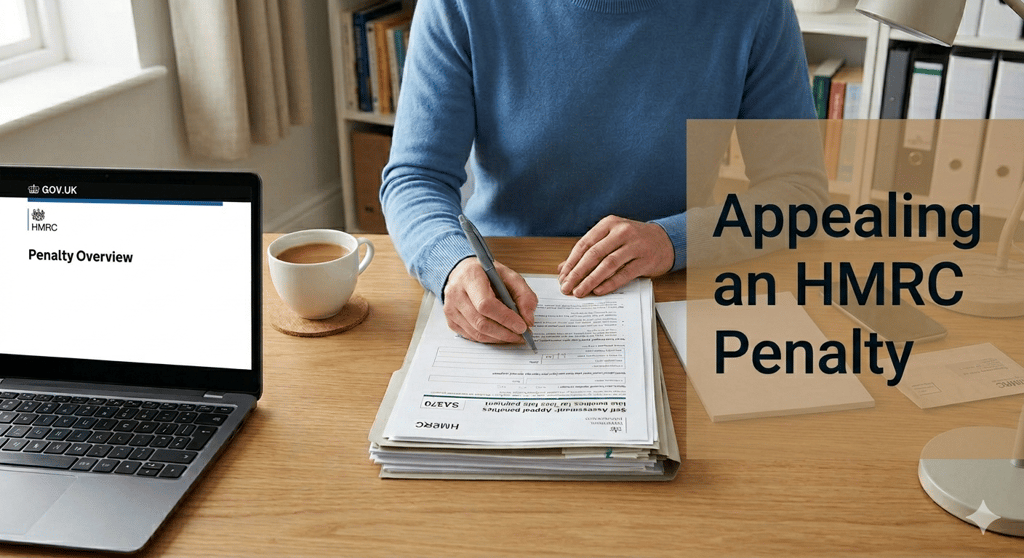
Getting a penalty notice from HMRC feels worse than it is.
That letter lands and the immediate instinct is to assume it is final. That HMRC has decided, the number is fixed, and the only question is how you are going to pay it.
That instinct is wrong.
If you have received a Self Assessment penalty and have a reasonable excuse for missing the deadline, you can submit an appeal. HMRC reviews appeals individually and cancels penalties that meet the criteria. The process is straightforward, the route is clear and the outcome, if your excuse is genuine, is often a complete cancellation of the charge.
What most people do not know is how to make an appeal that actually works. This post covers exactly that.
Before You Do Anything Else
There is one rule that trips up almost every first-time appellant.
HMRC will not accept your appeal until the Self Assessment tax return it relates to has been filed. If you haven't submitted your return yet, do that immediately.
This is not optional and it is not negotiable. An appeal submitted before the relevant return is filed will be rejected regardless of how strong your excuse is. File the return first even if it is incomplete, even if it is late, even if you cannot pay the tax yet. Then appeal the penalty.
The 30-Day Window
You must send your appeal to HMRC within 30 days of the date shown on your penalty notice.
This is the deadline that matters most and the one people most commonly miss. The clock starts from the date on the penalty notice, not the date you received it, not the date you opened the envelope.
Missing this crucial deadline can result in your appeal being automatically rejected, even if you have a strong reasonable excuse. If you have received a penalty notice, the very first thing to do is find the date on it and count 30 days forward. That is your hard deadline.
If you have already missed the 30-day window, all is not lost. Late appeals may be accepted if you explain the reason for the extra delay. But the bar is higher and you are relying on HMRC's discretion rather than your right to appeal. Do not put yourself in that position if you can avoid it.
What Is a Reasonable Excuse?
This is the core of any appeal. Without a reasonable excuse, there is no appeal.
HMRC says a reasonable excuse is "something that stopped you meeting a tax obligation for a valid reason", so it must be an issue you couldn't have reasonably avoided.
The key word is unavoidable. HMRC is not looking for a sad story. It is looking for evidence that something genuinely outside your control prevented you from filing or paying on time, and that you acted as quickly as you reasonably could once the obstacle was removed.
The 6 Excuses HMRC accepts:
Serious illness or hospitalisation, yours or a close family member's, particularly if it occurred close to the filing deadline and genuinely prevented you from meeting it. You will need medical evidence.
Bereavement of a close relative close to the deadline: A death certificate and a brief explanation of how the bereavement affected your ability to file is usually sufficient.
Technical failure : HMRC's website or online services were unavailable when you attempted to file. Screenshots of error messages with timestamps are your best evidence here.
Postal delays outside your control, if you were submitting a paper return with sufficient lead time.
Unexpected disasters — fire, flood or theft that destroyed your records or prevented access to them.
Incorrect information provided by HMRC itself, where you relied on their guidance and it turned out to be wrong.
Excuses HMRC does not accept:
Not receiving a reminder of the deadline: finding the return too complicated, relying on an accountant who failed to file, or being unable to pay.
Not knowing the deadline existed. The deadline is publicly available and HMRC expects you to be aware of your obligations.
Being too busy. This is the most common excuse submitted and one of the least successful. Everyone is busy. Busy is not unavoidable.
Cashflow problems or not having the money. This is not a reasonable excuse for late filing and it is not the right route for late payment either. Time to Pay is the correct mechanism for payment difficulties, not an appeal.
How to Submit Your Appeal
You have three routes.
Online- the fastest option.
Log into your HMRC online account, find the penalty notice, and select the Appeal option to complete the online form explaining your situation. You will get confirmation instantly. Armstrong Watson For straightforward cases this is the quickest route and gives you a clear record of submission.
By post using form SA370.
Download form SA370 to appeal by post. If you are in a partnership the nominated partner uses SA371 instead.
Send to: Self Assessment, HM Revenue and Customs, BX9 1AS. Keep a copy of everything you send and use tracked delivery so you have proof of the date.
By phone — for the £100 penalty only.
A phone appeal can only be made for the £100 late filing penalty. For daily penalties, six-month surcharges and payment penalties, you need to use the online or postal route.
How to Write an Appeal That Works
The quality of your explanation matters enormously. HMRC receives thousands of appeals. The ones that succeed are specific, evidenced and honest. The ones that fail are vague, emotional and unsupported.
Here is what every successful appeal includes.
Specific dates. Not "I was ill around January." Instead: "I was admitted to hospital on 24 January 2026 and discharged on 3 February 2026. The filing deadline of 31 January fell within this period."
A clear causal link. Show directly how the event prevented you from filing or paying. Do not assume HMRC will join the dots. Spell it out. "Because I was in hospital during the deadline period I was unable to access my records or complete my return."
Evidence. Attach copies — never originals — of anything that supports your case. Hospital letters. A death certificate. Screenshots of HMRC system error messages with timestamps. A letter from a doctor. The stronger your evidence, the stronger your appeal.
What you did when the obstacle was removed. HMRC expects you to act as soon as you reasonably could once the excuse no longer applied. You're expected to file your tax return as soon as you've recovered from a medical issue. If there was a gap between your excuse ending and you filing, explain it.
Honesty. Do not exaggerate. Do not invent detail. HMRC can and does verify claims and a dishonest appeal that is caught is significantly worse than no appeal at all.
What Happens After You Submit
HMRC will write to you with their decision. This typically takes six to eight weeks, but may be longer during peak Self Assessment periods.
There are three possible outcomes.
Your appeal is accepted and the penalty is cancelled in full. This is the outcome for genuine excuses that are well evidenced and clearly explained.
Your appeal is partially accepted and the penalty is reduced. Less common but it does happen, particularly where HMRC accepts the excuse for part of the penalty period but not all of it.
Your appeal is rejected. This does not mean the matter is closed.
If HMRC Rejects Your Appeal.
A rejection is not the final word.
You can ask HMRC to review the decision if you disagree with the outcome. This is called a statutory review and is carried out by an HMRC officer who was not involved in the original decision. It is free and does not require a tribunal.
If the statutory review also goes against you, the next step is the First-tier Tax Tribunal, an independent body that hears tax appeals. The tribunal is also free to use and you do not need legal representation, though for larger penalties it may be worth considering professional support.
The tribunal route is worth taking if you genuinely believe your excuse is valid and HMRC has applied the rules incorrectly. Many taxpayers who reach tribunal find that a clear, honest, well-evidenced case succeeds where the initial appeal did not, simply because the tribunal applies the rules independently rather than as an HMRC officer.
The Honest Advice on When Not to Appeal
An appeal is worth making when you have a genuine, unavoidable excuse that you can evidence clearly.
It is not worth making when the real reason was that you forgot, were disorganised, did not have the money or did not know about the deadline. Submitting a weak appeal wastes time, delays resolution and does not change the outcome. If the penalty is due, the better approach is to pay it, understand why it happened and build a system that prevents it from happening again.
That is not a failure. It is the right response to the situation.
The System That Makes Sure There Is Nothing to Appeal
The best appeal is the one you never need to make.
The UK Sole Trader Tax Template tracks your income and expenses throughout the year, calculates your complete January position automatically, and keeps your financial records in order from day one. When deadlines arrive, you are ready — not scrambling.
Get the UK Sole Trader Tax Template — £9.99 →
If you have received a penalty and are not sure whether your circumstances give you grounds for a genuine appeal, a Done With You session will give you a clear answer and help you put the right response together.
Book a Done With You session →
Blog content is for information purposes only and over time may become outdated as the tax landscape is constantly changing, although we do strive to keep it current and up to date. It is written to help you understand your taxes and is not to be relied upon as professional accounting, tax and legal advice. For additional help please contact a professional adviser
Bookkeeping
Email:
Contact Us
support@rhodiumaccounting.co.uk
Monthly Management Reporting
Budgets & Forecasts
Cash flow Optimisation
Processes and Controls
Other Services

