
How to Use Google Sheets as Free Accounting Software for Sole Traders and Small Businesses in the UK
Google Sheets is a free and legitimate bookkeeping system for UK sole traders and small businesses. Here is a practical four-tab setup that tracks income, expenses and profit and produces a real profit and loss statement at no cost.
BOOKKEEPING
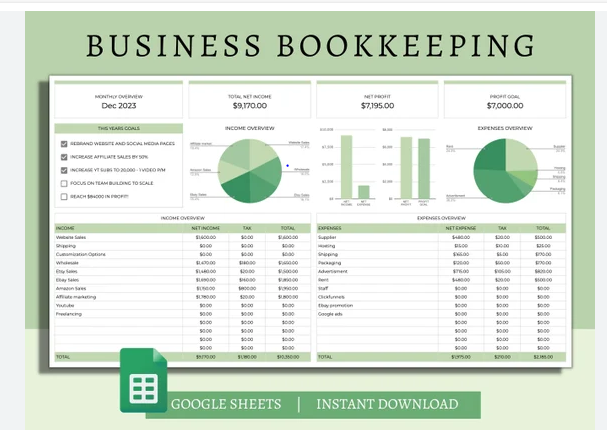
You have just gone self-employed, or you are a few weeks into a side hustle that is starting to generate real money. You need to track what is coming in and what is going out. You do not want to commit to a monthly software subscription for a business that is still finding its feet.
Google Sheets is the right answer for where you are right now. It is free, it works in a browser without installing anything, it saves automatically, and it is accessible from any device. For a sole trader or early-stage small business in the UK it does everything you actually need at this stage: tracking income, recording expenses, calculating profit, and giving you a clear picture of your financial position at any point in the year.
This post walks you through a practical four-tab setup that gives you a proper bookkeeping system in Google Sheets, not a rough running total in a single tab, but a structured system that produces a real profit and loss statement at the end of the period.
When Google Sheets Is the Right Tool
Not every business needs dedicated accounting software from day one. Software costs money every month, takes time to set up, and has features you will not use until your business reaches a certain scale. A sole trader testing a new service, a side hustler in the early stages, or a freelancer just starting out does not need bank feeds, VAT filing integration or multi-currency support. They need to know their income, their costs, and their profit. Google Sheets handles all three.
Where Google Sheets starts to show its limits is when your gross income approaches £50,000, where Making Tax Digital for Income Tax requires digital submissions using compatible software, or when your transactions become too numerous to manage manually. At that point the question of whether to move to software or a dedicated tax template becomes relevant. But that is a decision for later, and there is a significant middle ground between a basic Google Sheet and a full monthly software subscription that most early-stage businesses skip over entirely.
If you are selling goods or services and wondering whether what you earn even counts as taxable income, our sole trader bookkeeping guide covers the fundamentals of what records HMRC expects you to keep and how long you need to keep them.
What You Need to Track
Before setting up any system, it helps to be clear on what the system needs to produce. For a UK sole trader your bookkeeping needs to give you four things at any point during the year.
Your total gross income. The full amount received from sales or services before any deductions. Not what arrived in your bank after fees or costs came out. The full original amount before anything was taken off.
Your total allowable expenses. Everything you have paid out for the business that HMRC permits as a deduction against your income. Depending on your type of business this includes postage, packaging, mileage, home office costs, mobile phone, subscriptions and professional fees. Our post on claiming your home office as a sole trader and our guide to claiming your mobile phone as a business expense cover the two most commonly missed deductions in detail.
Your trading profit. Gross income minus allowable expenses. This is the figure your income tax and Class 4 National Insurance is calculated on.
Your tax liability and the amount to set aside. Knowing your profit throughout the year means January is never a surprise. Our guide to saving the right amount for your Self Assessment bill covers the set-aside percentages that work for different income levels and income types.
The four-tab setup below produces all of these automatically once it is built correctly.
The Four-Tab Setup
Create a new Google Sheet and set up four tabs named exactly as follows.


Tab 1: Business Details
This tab holds the reference information the rest of the sheet pulls from. Add your business name, the start date of your accounting period, and the end date. For most sole traders this is 6 April to 5 April to match the UK tax year, though if you are tracking a shorter test period for a new idea, use whatever dates apply.
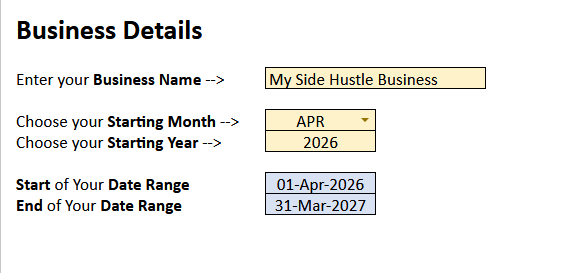
This tab does not need to be elaborate. Its purpose is to give the rest of the sheet a reference point so that any date-based calculations know which period they are covering. One row for business name, one for start date, one for end date is sufficient.
Tab 2: Chart of Accounts
This tab lists every category of income and expense your business uses. Think of it as the master list the rest of the sheet references when categorising transactions. Getting this right at the start saves considerable time later because it prevents you from recording the same type of expense under three different names across the year.
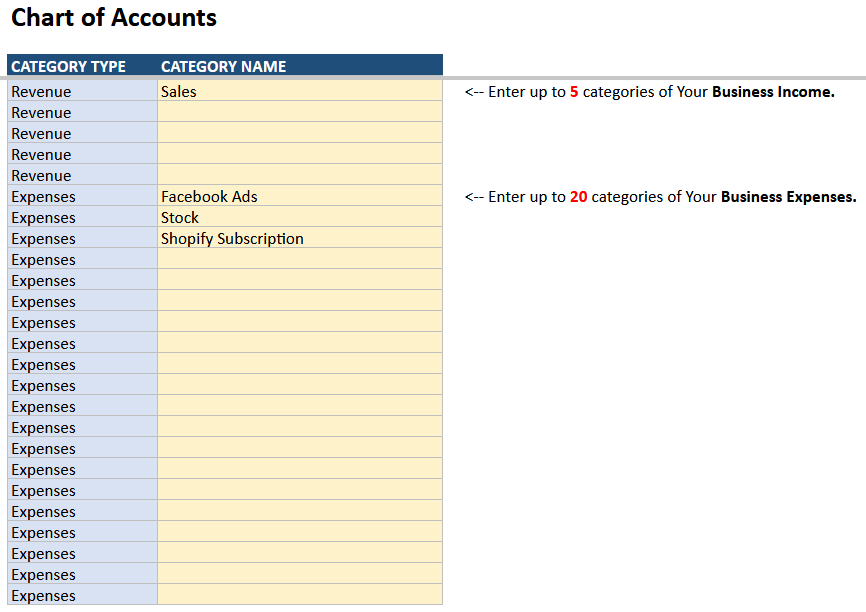
Your income categories depend on your business type. A service business such as a freelance designer or consultant might list different project types or client types as separate income streams. A product seller might list different product lines or sales channels to see performance at a glance.
Your expense categories should reflect every cost you are genuinely likely to incur. Common ones across most sole trader businesses include mileage, home office costs, mobile phone, subscriptions, professional fees and any materials or stock purchased for the business. Build the list before you start entering transactions, not as you go, because adding categories mid-year creates inconsistencies in your records that are tedious to unwind.
Tab 3: Transactions
This is the working tab where every income receipt and every expense payment is recorded. The layout uses four columns: Date, Category, Amount and Description.
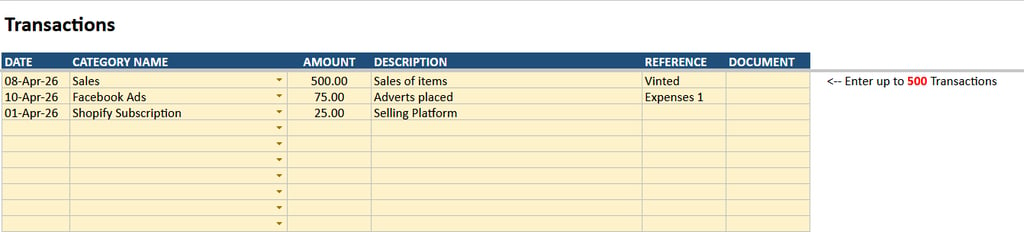
The Category column pulls from the Chart of Accounts tab using a dropdown validation, which means every transaction is categorised consistently using the same terminology across the whole year. The Description column is free text. Be specific. "Packaging materials, Amazon, 14 June" is a useful record. "Supplies" is not, particularly if HMRC ever asks for evidence of a specific expense.
Display income entries in black and expense entries in red. This makes the tab scannable at a glance and immediately flags anything unusual without needing to read every row carefully.
Record the full gross amount you received or paid, not the net figure after any deductions. If you received a payment and a fee was deducted before it hit your account, the correct entry is the full original amount as income and the fee as a separate expense. This keeps your gross income figure accurate, which matters because the key HMRC thresholds that affect your tax position, including the £1,000 trading allowance threshold and the Self Assessment registration requirement, are all based on gross income rather than net receipts. Our post on why your bank balance is not your profit explains this distinction and what happens when you get it wrong.
Setting up the SUMIF formulas in this tab requires basic spreadsheet skills but nothing advanced. The formula pulls all transaction amounts matching a given category from the Transactions tab and sums them. Once one row is working correctly every other row follows the same pattern. The formula itself looks like this: =SUMIF(Transactions!B:B,A5,Transactions!C:C) where column B in the Transactions tab holds the category, A5 is the category name in the Income Statement, and column C holds the amounts.
For online sellers on Vinted, eBay or Etsy
If you sell on online platforms, the Transactions tab needs one additional discipline that service business owners do not face: recording gross sale prices rather than net payouts.
On eBay, the platform deducts its Final Value Fee before paying you. On Etsy, transaction fees, listing fees and payment processing fees all come out before the money arrives. If you record what arrived in your account rather than the full original sale price, you are understating your gross income. The fees themselves are legitimate expenses and should appear as a separate expense entry in your transactions, but the income entry must reflect the full sale price.
Vinted works differently. Vinted charges sellers no fees at all. The buyer pays a protection fee on top of your listing price. Your income entry for a Vinted sale is simply the listing price, which is also exactly what arrives in your wallet. No adjustment needed.
The practical implication is that for eBay and Etsy sellers, your income figure in Google Sheets will be higher than your bank balance suggests, and the difference is accounted for by the fees sitting in the expense column. Your gross income is what HMRC receives from platform reporting under DAC7. If your Google Sheet matches that figure, your records will hold up if HMRC ever cross-references their platform data against your declared income.
Our post on tax across multiple platforms covers how the combined gross income from several platforms feeds into a single tax position, which is particularly relevant if you are selling across more than one channel at the same time.
Tab 4: Income Statement
This is where everything comes together. The Income Statement tab pulls from the Transactions tab using SUMIF formulas to aggregate income and expenses by category and produce the profit figure at the bottom.
The layout shows all income streams at the top, all expense categories below, and the net difference as your trading profit. This is the figure that goes on the self-employment pages of your Self Assessment return. It is also the figure you use to calculate how much tax to set aside from each payment you receive throughout the year.
Setting up the formulas requires basic spreadsheet skills. Once one row is working correctly, every other row follows the same pattern. The formula for each row pulls all transactions in a given category from the Transactions tab and sums them. If you have set up your Chart of Accounts cleanly and been consistent with your transaction categories, the Income Statement builds itself from the data you have already entered.
The Limitations You Will Hit as You Grow
Google Sheets works well as a starting point. The friction begins when your transaction volume grows beyond roughly 200 to 300 entries per year, when you need calculations that account for a day job salary alongside self-employment profit, or when your income approaches the level where Making Tax Digital submissions become mandatory.
At that point the right next step for most sole traders is not a monthly software subscription. It is a purpose-built tax template that handles the calculations Google Sheets cannot easily produce: the interaction between self-employment income and PAYE employment income, student loan repayments across all five plans, payment on account in the second year, and the trading allowance versus actual expenses comparison run automatically against your real figures.
Our post on template versus software versus accountant covers exactly that decision, including who each option is genuinely right for and the honest cost comparison between all three.
Download the Free Template
If you would prefer not to build the four-tab setup from scratch, you can download a ready-made version that is set up and ready to use.
Free Google Sheets Bookkeeping Template →
When your business grows beyond what the free template handles comfortably, the UK Sole Trader Tax Template and the UK Online Seller Tax Template are the purpose-built next step. Both are updated every April for the new tax year, work in Google Sheets and Excel, and calculate your complete tax position including the exact figures that go on your Self Assessment return.


Bookkeeping
Email:
Contact Us
support@rhodiumaccounting.co.uk
Monthly Management Reporting
Budgets & Forecasts
Cash flow Optimisation
Processes and Controls
Other Services

