The Real Cost of Filing Your Self Assessment Late: Self Assessment Penalties and Charges
Missing the Self Assessment deadline costs far more than the £100 fine most people expect. Here is the full self assessment penalties and charges structure for late filing and late payment, what to do if you have already missed a deadline, and how Time to Pay works.
SELF ASSESSMENT TAX RETURNS
Most sole traders know there is a penalty for missing the 31 January deadline.
Almost none of them know what it actually costs. And that gap in knowledge is exactly what turns a manageable situation into an expensive one.
The standard assumption is this: miss the deadline, get a £100 fine, sort it out when you are ready.
That assumption is wrong. The £100 is not the penalty. It is the starting point of a penalty system that escalates automatically, compounds over time, and can add nearly £2,000 to a £5,000 tax bill if nothing is done for twelve months.
This post explains exactly how the penalty system works, what happens if you have already missed a deadline, and the options most sole traders never find out about until it is too late to use them effectively.
Two Separate Penalty Systems Running at the Same Time
The first thing to understand is that HMRC operates two completely separate penalty systems for Self Assessment. One for filing late. One for paying late. They run simultaneously and they stack on top of each other.
Missing the 31 January deadline with an unpaid bill does not trigger one set of penalties. It triggers two. Understanding them separately is the only way to understand the full picture.
The Late Filing Penalties
These apply from the moment your return is late, regardless of whether you owe any tax at all.
The critical thing most people do not know is that the £100 penalty is automatic on day one. It is not negotiable and it does not require HMRC to contact you first. It simply appears on your account the moment the deadline passes.
The Late Payment Penalties
These are separate from the filing penalties and apply to any unpaid tax, regardless of whether the return has been filed.
Interest runs from day one on the full unpaid balance and continues until the debt is cleared in full. It is not compound interest but it accrues daily, so every day of delay adds to the total.
This is not an extreme scenario. This is what happens when someone decides the £100 fine is manageable and waits until they are ready to deal with it.
The One Thing That Stops the Filing Penalties Immediately
Filing your return stops the filing penalty clock. Immediately. Even if you cannot pay a penny.
Late filing penalties and late payment penalties are completely separate. Filing without paying stops the first set from escalating further. It does nothing to the second set, which continue to run on any unpaid balance. But the filing penalties are the ones that escalate most aggressively and most quickly.
HMRC accepts returns filed with estimated figures. You are not required to have perfect records before you submit. File with your best estimates, stop the clock, then amend the return once you have accurate figures. Amendments can be made up to twelve months after the original filing deadline.
This is arguably the most valuable piece of practical knowledge in this entire post. A sole trader who cannot file a perfect return by 31 January should file an imperfect one. Every day of delay costs money. A return filed on time with estimated figures, amended later with accurate ones, eliminates the filing penalty escalation entirely.
If You Have Already Missed the Deadline
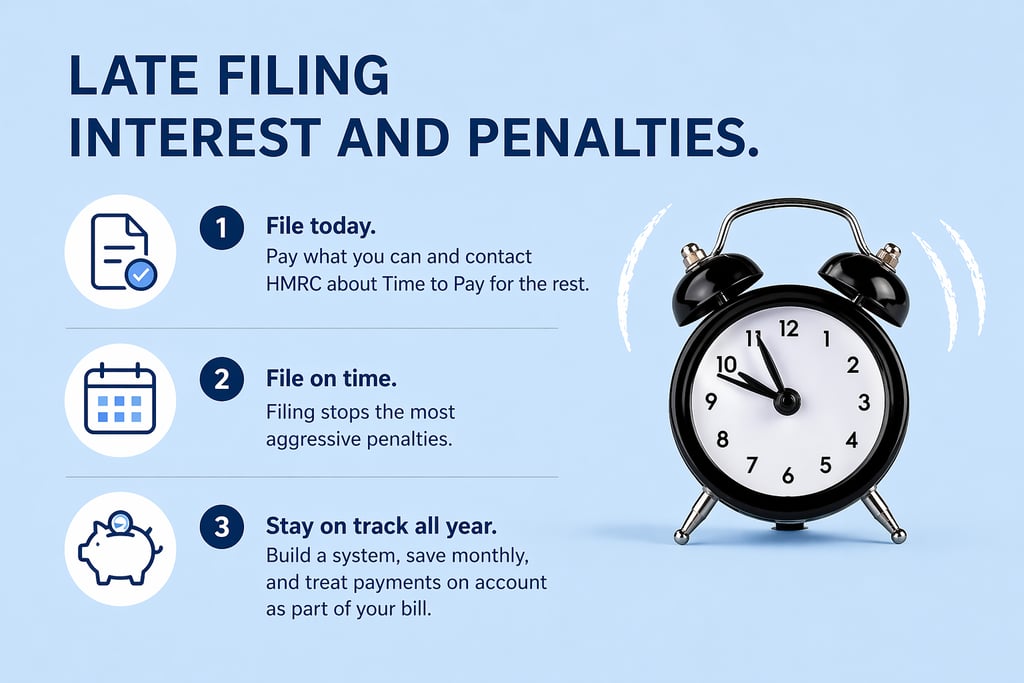
Do these three things in order, today.
File immediately. Even if your records are incomplete. Even if you cannot pay. Even if it is months past the deadline. Filing now stops the daily penalties from continuing to accumulate. It does not reverse the penalties already charged, but it stops new ones from being added. The sooner you file, the less the total cost.
Pay as much as you can on the same day. The late payment surcharges and interest are calculated on the outstanding balance. Every pound you pay reduces the balance on which future charges are calculated. Partial payment is not a substitute for full payment, but it is significantly better than no payment.
Contact HMRC to arrange Time to Pay for the remainder. Do this on the same day you file if possible. This is covered in full in the next section.
Your Way Out -Time to Pay Option.
Most sole traders who cannot pay their January bill in full believe they have two choices. Pay what they can and face the consequences for the rest, or borrow money to cover the full amount.
There is a third option. It is called Time to Pay. It is a formal agreement between you and HMRC to spread your tax bill over monthly instalments. HMRC actively offers this arrangement but almost never advertises it, and it does not appear anywhere in the standard reminder communications sent before the January deadline.
Here is what you need to know about how it actually works.
For bills under £30,000 you can usually set up a Time to Pay arrangement online through your Government Gateway account without speaking to anyone. For larger bills a phone call to the HMRC Self Assessment helpline is required.
The arrangement must be requested proactively. HMRC responds very differently to someone who contacts them before or immediately after the deadline than to someone who ignores the debt until HMRC chases them. Proactive contact signals good faith. Silence signals avoidance. The terms you are offered will reflect which category you appear to be in.
Interest continues to accrue during the repayment period at the current rate of 7.25% per year. This is a real cost but it is significantly lower than a credit card or personal loan, and once the arrangement is in place it stops the fixed penalty surcharges from escalating further.
HMRC will ask about your income and expenditure and the reason you cannot pay in full. A genuine cash flow explanation a late-paying client, an unexpected expense, a quieter trading period produces a more accommodating response than a vague or unconvincing answer. Have a simple summary of your financial position ready before you make the call or submit the online application.
The typical repayment period for a sole trader with a straightforward debt under £10,000 is three to twelve months. HMRC assesses each case individually but most reasonable requests are accommodated within this range.
July payments on account can be handled the same way. This is the part almost nobody knows. If you successfully arrange Time to Pay for your January bill but know the July payment on account will also be difficult to meet, you can contact HMRC separately before the July deadline and request a Time to Pay arrangement for that payment as well. These are treated as independent arrangements. Most sole traders who use Time to Pay in January default on July unnecessarily because nobody told them the same option was available.
The broader principle is this. HMRC is not primarily interested in penalising sole traders who cannot pay. It is interested in collecting the tax owed. Proactive communication, an honest explanation and a credible repayment proposal will almost always produce a better outcome than silence.
The moment you know you cannot pay in full, contacting HMRC is the single most effective financial action you can take. Every day of delay makes the situation more expensive and the negotiating position weaker.
How to Make Sure This Never Happens Again
The penalty system described in this post is entirely avoidable. Not through luck or timing, but through one habit applied consistently throughout the year.
Knowing your January total before January arrives.
Every surprise tax bill has the same root cause. The sole trader did not know what was coming, so they did not save for it. By the time they found out, the money was gone.
The fix is not complicated. It is a bookkeeping system that tracks your income and expenses throughout the year, a Tax Planner that calculates your estimated bill in real time, and a separate savings account where the right percentage goes every month.
Know your number. The total due in January is not just your tax bill. It includes your first payment on account 50% of your bill on top, due the same day and any student loan repayment if applicable. These are the figures that most commonly produce the January shock. Most sole traders save for the tax but not for the payment on account. The shortfall arrives without warning.
Save the right percentage. A rough rule of 25 to 30 percent of profit is a reasonable starting point. It is not always the right number. A sole trader with profits above £50,270 faces a higher effective rate. A sole trader with a student loan needs to add the repayment figure on top. The UK Sole Trader Tax Template calculates your actual estimated January total automatically based on your specific profit level, tax rates, student loan plan type and payment on account — so you know the right number to save toward from day one of the tax year.
Keep it separate. The sole traders who consistently meet their January bills without stress share one habit. The tax money is in a different account. It does not feel available to spend, because it is not. When January arrives it is a transfer, not a crisis.
The Reasonable Excuse Exemption
One final thing worth knowing.
If you missed a deadline for a reason that was genuinely outside your control, you can appeal the penalty. HMRC accepts what they call a reasonable excuse, which covers situations such as serious illness, bereavement of a close family member, unexpected hospitalisation, or an HMRC system failure that prevented you from filing.
HMRC does not accept not knowing the deadline, finding the return too complicated, or relying on an accountant who failed to file.
If you believe you have a genuine reasonable excuse, submit your appeal using form SA370 or through your Government Gateway account within 30 days of receiving the penalty notice. If HMRC rejects the appeal you can escalate to the First-tier Tax Tribunal.
Appeals are worth making if the excuse is genuine. They are not worth making as a delay tactic — HMRC distinguishes between the two quickly and an unsuccessful appeal wastes time while interest continues to accrue.
Get the UK Sole Trader Tax Template — £9.99 →
Know your January total before January arrives. Income tax, Class 4 NI, student loan repayment and payment on account calculated automatically from your records throughout the year.
Blog content is for information purposes only and over time may become outdated as the tax landscape is constantly changing, although we do strive to keep it current and up to date. It is written to help you understand your taxes and is not to be relied upon as professional accounting, tax and legal advice. For additional help please contact a professional adviser.
Bookkeeping
Email:
Contact Us
support@rhodiumaccounting.co.uk
© 2026. All rights reserved | Privacy Policy | Terms and Conditions
Monthly Management Reporting
Budgets & Forecasts
Cash flow Optimisation
Processes and Controls
Other Services

