Your Money Is Shrinking and Your Bank Is not Going to Tell You.
Your money isn't as safe as you think because inflation is silently eroding its value every single year. Simple alternatives like high-interest savings accounts, index funds, bonds, and gold can make a dramatic difference to your wealth. The gap between idle cash and invested cash can be life-changing.
INCOME AND INVESTMENTS
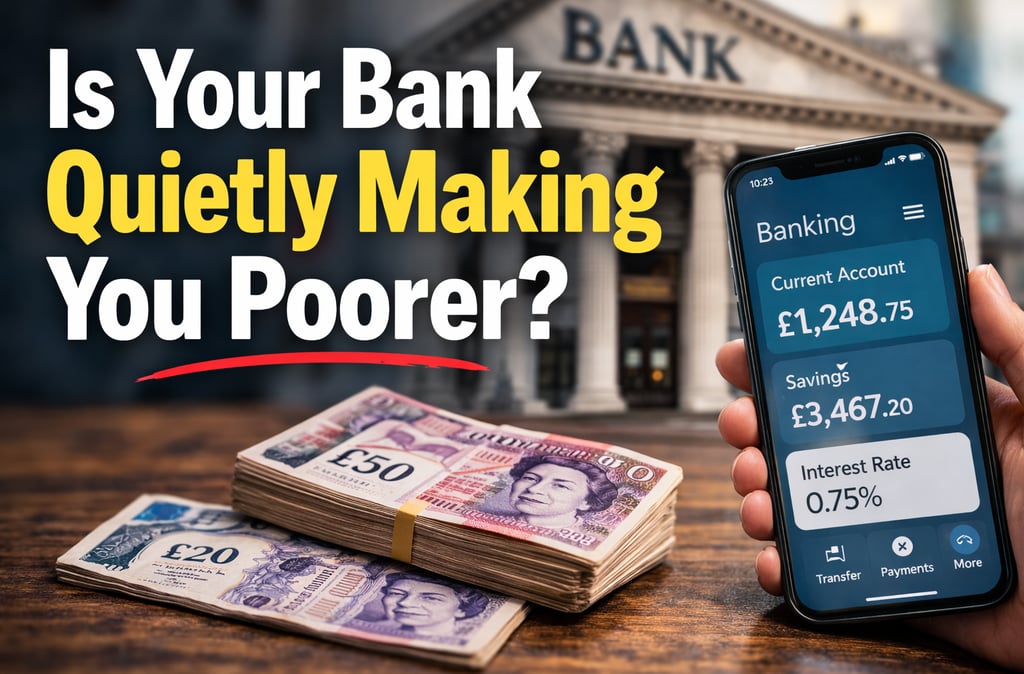
Picture this: it's a Sunday morning. You open your banking app, scroll to your savings balance, and feel a quiet sense of satisfaction. The number hasn't gone down. In fact, it's exactly where you left it six months ago. Everything looks fine.
But here's the thing. It's not fine. Not really.
While that number sat still, inflation kept moving. The price of your weekly shop crept up. Your energy bills nudged higher. A holiday that used to cost £800 now costs £950. Your money didn't shrink on paper, but its purchasing power (what it can actually buy you in the real world) quietly declined.
This is the silent tax that most people never talk about. And as a chartered accountant, it's one of the most common and costly mistakes I see: people leaving large sums of money sitting idle in current accounts, month after month, year after year, while inflation slowly eats away at its value.
So what can you do about it? Let's walk through four options, from the simple to the more sophisticated, that can put your cash to work.
1. High-Interest Savings Accounts: The Easiest Win You're Probably Missing
Let me tell you about a client of mine. I'll call her Sarah. She was a sensible, hard-working professional in her early forties who had diligently saved throughout her career. When we sat down to review her finances, I noticed she had £40,000 sitting in a current account earning 1% interest.
"I just keep it there," she said. "I've banked with them for twenty years. It feels safe."
Safe, yes. But it was quietly costing her a fortune. At 1%, her £40,000 was earning £400 a year. When we moved it to a high-interest savings account offering 7%, it started earning £2,800 a year instead. That's an extra £2,400 annually, simply by switching bank accounts.
Sarah's story isn't unusual. Research suggests there is around £30 billion sitting in UK bank accounts earning no interest at all. Millions of people are unknowingly leaving enormous sums of money on the table, held back by one of three things: loyalty to their bank, the assumption that switching is complicated, or simply underestimating how much the difference actually matters.
Here's the truth about bank loyalty: your bank does not reward it. In fact, banks often reserve their best interest rates for new customers, while long-standing ones quietly earn almost nothing. The relationship you've built over two decades means very little when it comes to what interest rate you're offered.
The good news? High-interest savings accounts are just as safe as regular ones. In the UK, deposits are protected by the Financial Services Compensation Scheme (FSCS) up to £85,000 per person per institution. You're not taking on risk. You're simply choosing a better deal.
The practical first step is simple: open your banking app right now and check what interest rate you're currently earning. Then compare it to the best available rates today. If there's a significant gap (and for most people there is), switching could be one of the easiest financial wins of your life.
2. Index Funds: Let the World's Best Companies Work for You
Now let's step up a level. Because while a high-interest savings account will beat idle cash, it probably won't build the kind of long-term wealth that changes your life. For that, we need to talk about investing, and specifically about a tool so powerful that even Warren Buffett has recommended it for most ordinary investors.
The index fund.
Imagine you could invest in Apple, Amazon, Microsoft, Tesla, and nearly 500 other major companies all at once, with a single purchase, for a tiny annual fee. That's essentially what an S&P 500 index fund does. It tracks the 500 largest publicly traded companies in the United States and gives you a proportional stake in all of them.
When those companies collectively do well, and over the long run they historically have, your investment grows with them.
Here's a number that should stop you in your tracks: since 1957, the S&P 500 has delivered an average annual return of around 10%. Some years are terrible; some are spectacular. But the long-term trend has been relentlessly upward.
Let's make that concrete with a tale of two savers.
Two friends, both aged 25, each have £10,000 to spare. The first, James, parks his money in a current account earning 1% interest. The second, Emma, invests hers in an index fund averaging 8% annual returns. Neither touches the money for 50 years.
At 75, James opens his account to find roughly £16,000. Meanwhile, Emma's £10,000 has grown to approximately £469,000.
Same starting amount. Same timeframe. A difference of nearly half a million pounds, produced entirely by compound growth over time.
Of course, investing does come with risk. The market goes up and down, and there will be years (sometimes painful ones) where your portfolio loses value. This is why financial experts typically recommend keeping three to six months of living expenses in accessible savings before investing a penny. That emergency buffer means you'll never be forced to sell your investments at the wrong moment.
But once that cushion is in place, the cost of not investing becomes very real. Every year of idle cash is a year of compound growth you'll never get back.
3. Bonds: Predictable Returns in an Unpredictable World
Not everyone has the stomach for stock market investing, and that's completely understandable. Markets can be volatile, and watching the value of your savings drop by 20% in a bad year is deeply uncomfortable, even if you know it's likely to recover.
That's where bonds come in. And if you've never looked at them before, they're simpler than they sound.
Think of a bond as an IOU. When you buy one, you're lending money to a government or company. In return, they promise to pay you a fixed rate of interest at regular intervals, and to return your original investment when the bond matures. It's a contract, and unlike stocks, the return is known upfront.
Let's say you purchase a UK government bond (called a gilt) worth £10,000 with a fixed interest rate of 4.5% over two years. You'll receive £450 in year one and £450 in year two. At the end of the term, your original £10,000 is returned. Total earnings: £900. No guesswork, no anxiety, no checking the news every morning.
This predictability is bonds' greatest advantage. Savings account interest rates can shift whenever the Bank of England changes base rates. Bond rates, by contrast, are typically locked in at the time of purchase. If you buy a bond at 4.5% today and rates fall next year, you keep earning 4.5%.
There can also be meaningful tax advantages. For investors who have already used their ISA allowance or personal savings allowance, bonds structured in certain ways can be particularly tax-efficient. It's worth speaking to a financial adviser if this applies to you.
Bonds won't deliver the same explosive long-term growth as stocks. But they serve a different purpose: they offer stability, predictability, and a meaningful return on capital. Far better than letting your cash collect dust.
4. Gold: The Ancient Hedge Against Modern Uncertainty
Gold is one of humanity's oldest stores of value. For thousands of years, long before banks existed and long before stock markets were invented, people have trusted gold to hold its worth when everything else feels uncertain.
That ancient instinct turns out to be well-founded. Gold has historically performed strongly during periods of high inflation, geopolitical tension, or financial turmoil: precisely the moments when other assets tend to struggle. In recent years, as global uncertainty has risen, so has the price of gold, as investors worldwide have flocked to it as a safe haven.
If you are considering adding gold to your portfolio, you have two main options.
The first is buying physical gold: coins or bars from reputable institutions like the Royal Mint. There is something undeniably satisfying about holding a gold coin in your hand. But physical gold comes with practical challenges: it needs to be stored securely, often at additional cost, and insured against theft or loss.
The second option is far more practical for most people: gold-tracking funds, known as exchange-traded commodities (ETCs). These investment vehicles track the price of gold, allowing you to benefit from its movements without ever needing to handle the metal itself. You can buy and sell them through most investment platforms in minutes.
Gold is not for everyone. It produces no income and its price can be volatile in the short term. But as part of a balanced approach, it can serve as a useful counterweight when inflation rises or markets fall. Think of it less as a growth investment and more as an insurance policy for your wealth.
The Real Threat Is not What You Think It Is
When people think about financial risk, they tend to imagine dramatic scenarios: a stock market crash, a bank failure, a company going bust. These are the risks that make headlines and keep people up at night.
But in my experience, the biggest financial risk facing most people isn't dramatic at all. It's quiet. It's slow. And it's completely avoidable.
It's the risk of doing nothing.
Idle cash sitting across multiple accounts, forgotten about and never reviewed, is particularly common among freelancers, business owners, and landlords who manage several bank accounts at once. It's easy for money to pool in low-interest accounts without anyone noticing, simply because it's out of sight.
And all the while, inflation works in the background. Silently. Patiently. Eating away at the real value of that money year by year.
The antidote isn't to take wild risks with your money. It's to become intentional about it.
So, What Should You Actually Do?
Let's bring this back to earth with a practical framework.
Cash is not the enemy. Everyone needs accessible savings for emergencies and short-term goals. Having three to six months of living expenses in a liquid account is sensible financial planning, full stop.
But once you have that buffer, and many people have far more sitting idle than they actually need, the question becomes: what's the best use of the rest?
• Start with a high-interest savings account. Move your accessible savings there today. It takes 15 minutes and costs you nothing.
• Consider index funds for long-term wealth building. If you have money you won't need for five years or more, the stock market has historically been the most powerful wealth-building tool available to ordinary people.
• Look at bonds if you want certainty. Fixed returns, locked-in rates, and potentially useful tax advantages make them a compelling middle ground for many investors.
• Think about gold as a stabiliser. Not a core investment, but a useful hedge in volatile times, especially through low-cost ETCs.
The difference between idle money and invested money, compounded over decades, is not marginal. It can be the difference between a comfortable retirement and a stressful one. Between financial freedom and financial anxiety.
Back to that Sunday morning scenario. You open your banking app, scroll to your savings balance, and this time you see something different. Not just a static number sitting there, but money that's actually working. Growing. Compounding.
That feeling of satisfaction? Now it's actually justified.
Blog content is for information purposes only and over time may become outdated as the tax landscape is constantly changing, although we do strive to keep it current and up to date. It is written to help you understand your taxes and is not to be relied upon as professional accounting, tax and legal advice. For additional help please contact a professional adviser.
Bookkeeping
Email:
Contact Us
crystal@rhodiumaccounting.co.uk
© 2026. All rights reserved | Privacy Policy | Terms and Conditions
Monthly Management Reporting
Budgets & Forecasts
Cash flow Optimisation
Processes and Controls
Other Services

