
The HMRC Mileage Rate Has Increased to 55p: What UK Sole Traders Need to Claim in 2026/27
The HMRC mileage rate rose from 45p to 55p per mile from 6 April 2026, the first increase in 15 years. Here is what UK sole traders need to know, what it is worth, and how to claim it on Self Assessment.
SOLE TRADERS
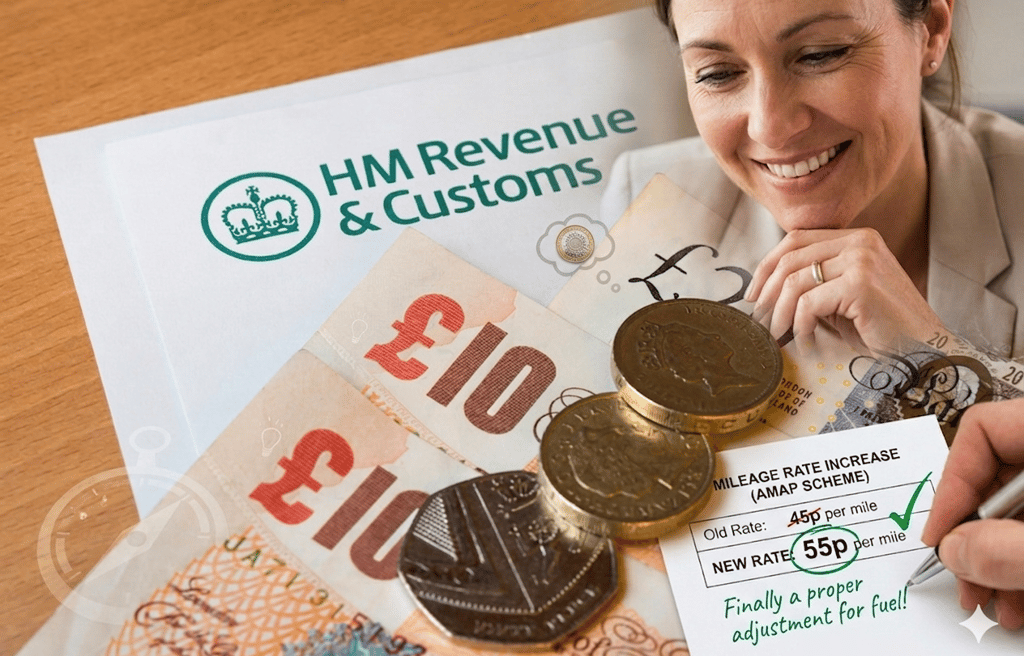
HMRC increased the approved mileage rate for the first time since 2011. From 6 April 2026, you can claim 55p per mile for the first 10,000 business miles in the tax year, up from 45p. Chancellor Rachel Reeves confirmed the change on 21 May 2026, backdated to the start of the tax year, so the full 10p increase applies across the whole of 2026/27.
The rate above 10,000 miles stays at 25p. Motorcycles are 24p, bicycles 20p. And despite what you might expect, there's no higher rate for electric vehicles. It's the same 55p regardless of what is under the bonnet.
Why a 15-Year Freeze Matters
The 45p rate dates back to 2011/12. Since then fuel prices have risen sharply, insurance costs have increased, and vehicle running costs generally are higher than they were. The approved rate is supposed to cover all of those costs, so a rate frozen for 15 years has quietly been worth less and less in real terms each year. The increase to 55p doesn't fully close that gap, but it's a meaningful step.
For sole traders who've been meticulous about logging their mileage, this is simply more money back. For those who haven't been logging consistently, this is a good moment to start.
What the 55p Rate Is Worth: Worked Examples
It's 10p per mile more than before. Here's what that adds up to.
At 5,000 miles a year the additional tax saving is £130 at the basic rate. At 8,000 miles it's £208. Mileage reduces your taxable profit, so every extra pound of claim reduces the profit that income tax and Class 4 NI are calculated on. At the basic rate the combined effect is around 26p saved for every additional pound claimed. At the higher rate it's closer to 42p.
There's a secondary benefit worth knowing. Because a larger mileage claim reduces your profit, it also reduces your payment on account, which is calculated as 50% of the previous year's income tax and NI. A higher mileage claim this year means a lower payment on account due in January and July next year. The compounding effect of getting mileage right is greater than most people realise.
Our guide to saving the right amount for your tax bill covers how expense claims like this affect how much to set aside from each payment you take.
Get the UK Sole Trader Tax Template, £14.99 →
What Counts as a Business Journey
The mileage rate applies to journeys made wholly and exclusively for business. Here are the common qualifying journeys by trade.
Tradespeople driving from home to a client's site qualify because each site is a temporary workplace. A plumber doing four jobs across a day claims all four legs. A consultant travelling to a client's office for a meeting qualifies. A freelancer travelling to a co-working space they don't use regularly qualifies. A photographer driving to a shoot location, a personal trainer driving between clients, a bookkeeper visiting clients at their premises, all qualify.
What doesn't qualify is the regular commute to a fixed workplace. If you rent a studio or office and drive there every day, that's a commute regardless of your employment status. And mixed-purpose journeys don't qualify. If you stop at a client on the way to doing your weekly shop, the journey fails the wholly and exclusively test.
The post office run qualifies when you're going specifically to send business parcels. The distinction matters, so make a note of the purpose at the time, not later.
The Passenger Rate Most Sole Traders Miss
If you carry a fellow employee or business partner as a passenger on a qualifying journey, you can claim an extra 5p per mile per passenger on top of the standard 55p. It's separate, applies in addition, and is logged the same way.
For most sole traders this won't apply often, but if you regularly take a member of staff or business partner to meetings or site visits, it adds up. Ten return journeys a month at 20 miles is £120 of additional deductible expense across the year.
The 10,000-Mile Threshold
The 55p rate covers the first 10,000 business miles per tax year per person. Not per vehicle. If you use two cars for business, the miles from both count toward the same threshold.
Above 10,000 miles the rate drops to 25p. A sole trader doing 12,000 business miles claims 10,000 at 55p and 2,000 at 25p, giving a total claim of £6,000 rather than the £6,600 they'd get if 55p applied throughout. Worth tracking if you're a higher-mileage driver.
Mileage Rate vs Actual Costs
For most sole traders the mileage rate wins, and at 55p the margin is wider than before. The actual costs method means tracking every fuel receipt, insurance renewal, MOT, service and tyre replacement, then calculating the business-use proportion based on your total annual mileage. More work, and usually a smaller claim.
A car costing £3,500 a year to run, driven 15,000 total miles of which 7,500 are for business, generates an actual cost claim of £1,750. At 55p the mileage claim is £4,125. That's a £2,375 difference in favour of the simpler method with no receipts to keep.
One interaction worth flagging. If you're using the £1,000 trading allowance, you can't also claim mileage separately. The allowance replaces all business expenses. If your mileage alone is worth more than £1,000, you're almost certainly better off claiming actual expenses. Our post on when not to use the trading allowance covers that decision.
The Records You Need to Keep
A mileage log. Each entry needs the date, start and end location, business purpose and miles. A note on your phone at the time is fine. A spreadsheet or a dedicated app such as MileIQ both work well. What doesn't work is a single annual total or anything reconstructed from memory in January.
HMRC can request records going back five years. Contemporaneous logs and end-of-year estimates look very different under scrutiny.
If you haven't been logging and your records are patchy for earlier months in 2026/27, start now and make a reasonable estimate for the period you can't fully reconstruct. A good-faith estimate based on your typical driving patterns is defensible. A blank log followed by a large claim is not.
Our sole trader bookkeeping guide covers the record-keeping habits worth building from the start of the year.
How to Claim on Your Self Assessment Tax Return
Mileage goes on the SA103 self-employment pages under vehicle and travel costs. Enter the total pound amount, not the miles. Multiply your qualifying business miles by 55p, add 25p for any above 10,000, and enter the total as a business expense.
The whole of 2026/27 uses 55p. If you were logging at 45p before the 21 May announcement, recalculate those earlier entries at the correct rate before you file. There's no amendment needed to any previous return. This tax year hasn't been filed yet.
If you haven't registered for Self Assessment yet, our post on what happens if you register late covers the process and the implications.
Bookkeeping
Email:
Contact Us
support@rhodiumaccounting.co.uk
Monthly Management Reporting
Budgets & Forecasts
Cash flow Optimisation
Processes and Controls
Other Services

