
How to Save for Your Sole Trader Tax Bill: A Simple Monthly System That Works.
A simple monthly system for UK sole traders to save the right amount for their January tax bill. Includes a set-aside table by profit level, payment on account handling, and a catch-up plan if you have fallen behind.
SELF ASSESSMENT TAX RETURNS
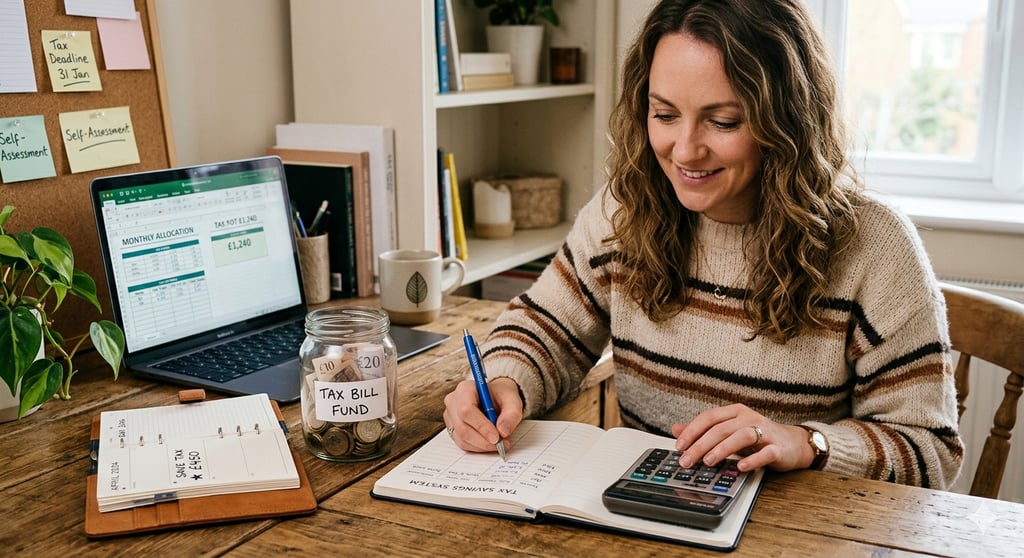

January is a stressful month for sole traders, but only for the ones who left it to January. The sole traders who find tax stress-free have the same habit, which is moving a fixed percentage of every payment into a separate savings account during the year so that by January the money is already there. This post walks through the simple system that makes that possible, including the right percentage to save based on your profit level, why a separate account matters, how to handle payment on account, and what to do if you have already missed the start of the tax year.
How Much UK Sole Traders Should Save for Tax.
Most generic advice says save 25% to 30%. That works for some sole traders and is wildly wrong for others. The right percentage depends on your annual profit level, which determines which tax band you sit in.
Here are realistic set-aside percentages based on the worked examples in our cornerstone post on how much tax sole traders pay in 2026/27, with example monthly amounts to make the maths feel real.
These percentages cover income tax, Class 4 National Insurance and the first payment on account toward the following year's bill. They assume you are claiming a reasonable level of actual business expenses, so if your expenses are unusually low your effective tax rate will be slightly higher and you should save a little more. If your expenses are unusually high, the percentage can come down. The figures do not include student loan repayments, which add another 6% or 9% depending on your plan, so if you have a student loan add a few percentage points on top.
If you want to see your exact number, the interactive calculator in our cornerstone tax post shows you what to save based on your specific profit, student loan plan and payment on account year.
Why a Separate Tax Savings Account Matters.
The single most important thing about this system is that the tax money does not live in your main business account. When tax money sits alongside your normal cashflow it looks like money you can spend, so you see a healthy balance, take a draw, pay yourself a bonus or buy a piece of equipment, and by January the money is gone even though you knew the bill was coming.
A separate account makes the tax money invisible to your day-to-day finances. You only see it when you log in to that specific account, and the rest of the time it does not exist as far as your spending decisions are concerned. This single behavioural shift is the difference between sole traders who find January manageable and sole traders who find it stressful.
You do not need anything fancy for the savings account. A standard business savings account from your bank works fine, and a separate personal savings account in your own name works fine too if you operate as a sole trader. The key features to look for are no minimum balance, no fees, and ideally some interest, even a small amount.
Most UK business banks now offer simple savings pot facilities at no cost. Monzo Business offers Tax Pots that automatically move a percentage of every incoming payment into a separate pot, available on their Pro or Team plans starting from £5 per month. Starling, Tide, Mettle and most high street banks offer similar features. If you already have a separate space in your existing banking app, use it. The mechanics matter less than the discipline.
The Habit That Makes January Easy.
The rule that makes this system work is simple. Every time a payment lands in your business account, move the relevant percentage into the tax savings account before you do anything else, and do it within 24 hours rather than at the end of the week or the month.
The reason for the speed is psychological. Money sitting in your main account for several days starts to feel like money you have, and by the time you remember to move it you have unconsciously planned what to spend it on. Move it immediately and the money never feels like yours in the first place. By the time you check the main account balance, the tax money is already gone.
If you find the manual transfer too easy to forget or skip, set up a standing order or use one of the automated tax pot features mentioned above. Some bank apps allow you to automate a percentage transfer every time money lands, which removes any reliance on your own discipline. This matters in busy weeks where the manual step is exactly what gets missed.
For sole traders who receive variable payments from multiple clients, a slightly different approach works well. Round up. If you have agreed to save 30%, save 35%. The extra cushions you against months where expenses are unexpectedly low and your effective tax rate is therefore higher. Any surplus at the end of the year is a bonus you can use to fund the following year's set-aside, smooth out a quieter month, or top up your pension contributions.
How Payment on Account Changes the Calculation.
This is the part that surprises most sole traders in their second year. If your total tax bill, including income tax and Class 4 NI, exceeds £1,000, HMRC requires you to make payments on account toward the following year's bill. The first payment on account is due alongside your main tax bill on 31 January, and the second payment on account is due on 31 July.
In practice this means your first January bill is 150% of your tax bill rather than 100%. The set-aside percentages in the table above already include this, but it is worth understanding why. If your tax bill on £35,000 of profit is £6,337, you also have to find £2,916 for the first payment on account, so the full January payment is £9,253. If you had only been saving for the £6,337 figure, you would be £2,916 short. The same principle applies the following July when the second payment on account of £2,916 is due, and the savings system needs to have built up by then too.
The cleanest way to handle this is to keep saving at the same percentage all year round. By the time July arrives you have continued to build up money for both the second payment on account and the next January's bill, so the system runs on a continuous rhythm rather than a stop-start one.
If your profit is genuinely going to be lower next year, you can apply to reduce your payments on account through your Self Assessment online account. This is the right step only if you have a real reason to expect lower profits, not as a way to defer the bill, because if your application is wrong and your actual profit is higher than expected HMRC will charge interest on the shortfall. If you find yourself facing a January bill you cannot cover even after saving consistently, our guide to HMRC's Time to Pay arrangement walks through how to spread the cost over monthly instalments.
What If You Have Already Missed the Start of the Tax Year?
This is the situation most sole traders are actually in. They start the tax year with good intentions and the system in place, by month three or four the discipline has slipped, and by the time they read a post like this they are halfway through the year and behind on the savings. The recovery plan is straightforward and does not require panic.
Work out your year-to-date profit and what your tax bill on that profit would be using the cornerstone tax post calculator, which gives you your current liability. Add what you have already saved into the tax account, and the gap between the two numbers is your shortfall. Divide the shortfall by the number of months remaining until your January tax deadline, and that is the catch-up amount you need to add to your normal monthly set-aside.
From this month onwards, save at the normal percentage plus the catch-up amount. If your normal set-aside is 22% and your catch-up requires an extra 8%, save 30% for the rest of the year. By January the shortfall is closed. If the catch-up amount is genuinely unaffordable on top of the normal set-aside, that tells you something important about your business sustainability at its current profit level after tax, and that is a conversation worth having with a qualified accountant rather than a savings problem.
Three Common Mistakes to Avoid.
A few patterns to watch for in any tax savings system.
The first is saving on turnover rather than profit. The set-aside percentages apply to your profit, which is your income after expenses. Saving 30% of your gross income when your expenses are 40% of turnover means you are saving roughly twice as much as you need to, and although the money is not lost the over-saving makes your cashflow unnecessarily tight.
The second is dipping into the tax account for emergencies. The tax account is not an emergency fund, and if you need an emergency fund you should build a separate one. The tax money is owed to HMRC and pretending it is yours to borrow against creates exactly the January crisis the system is designed to prevent.
The third is forgetting student loans. The set-aside percentages above assume no student loan, so if you have a Plan 2 student loan you should add around 4% to 5%, and if you have both an undergraduate loan and a postgraduate loan the figure is higher. Build the loan repayment into the set-aside from the start rather than treating it as a surprise.
A Note on National Insurance.
The set-aside percentages cover Class 4 National Insurance because Class 4 is paid through Self Assessment alongside income tax. Most sole traders no longer pay Class 2 National Insurance at all because the contributions are awarded automatically once profits exceed the small profits threshold. If your profits are below £7,105 for 2026/27 and you want to maintain your State Pension qualifying years, our guide to National Insurance for sole traders covers when voluntary Class 2 contributions are worth making.
For sole traders whose profits are pushing them above the £50,000 Making Tax Digital threshold, the savings system becomes even more important because the new quarterly reporting cycle means HMRC has earlier visibility of your year-to-date profit. Our main MTD guide walks through what MTD requires and the timetable for the threshold reductions over the next two years.
The System Summary.
A sole trader who has built the right habits checks their year-to-date profit each month, applies the appropriate set-aside percentage to every payment that lands, moves the money to a separate account within 24 hours, and lets it accumulate quietly until January. By the time the tax return is filed the bill is already covered, the transfer to HMRC is a routine accounting entry rather than a financial event, and the second payment on account in July is similarly painless. It is the same simple system applied consistently for the entire trading career, where the complexity is the maths around what percentage to save rather than the habit itself.
The Template That Does the Maths for You.
The UK Sole Trader Tax Template tracks your income and expenses throughout the year and calculates your real-time tax position automatically. The Tax Planner tab shows you exactly what you owe at any point in the year, broken down into income tax, Class 4 NI, student loan and payment on account, so you always know what the set-aside should be.
Get the UK Sole Trader Tax Template, £9.99 →
Blog content is for information purposes only and over time may become outdated as the tax landscape is constantly changing, although we do strive to keep it current and up to date. It is written to help you understand your taxes and is not to be relied upon as professional accounting, tax and legal advice. For additional help please contact a professional adviser.
Bookkeeping
Email:
Contact Us
support@rhodiumaccounting.co.uk
© 2026. All rights reserved | Privacy Policy | Terms and Conditions
Monthly Management Reporting
Budgets & Forecasts
Cash flow Optimisation
Processes and Controls
Other Services

