
"I Cannot Pay My Self Assessment Bill." Here Is Exactly What You Need to do Next.
Cannot pay your Self Assessment tax bill on time? Learn how to file immediately, set up an HMRC Time to Pay arrangement online, and avoid the 15% surcharges and 7.25% interest that build up on unpaid tax.
SELF ASSESSMENT TAX RETURNS
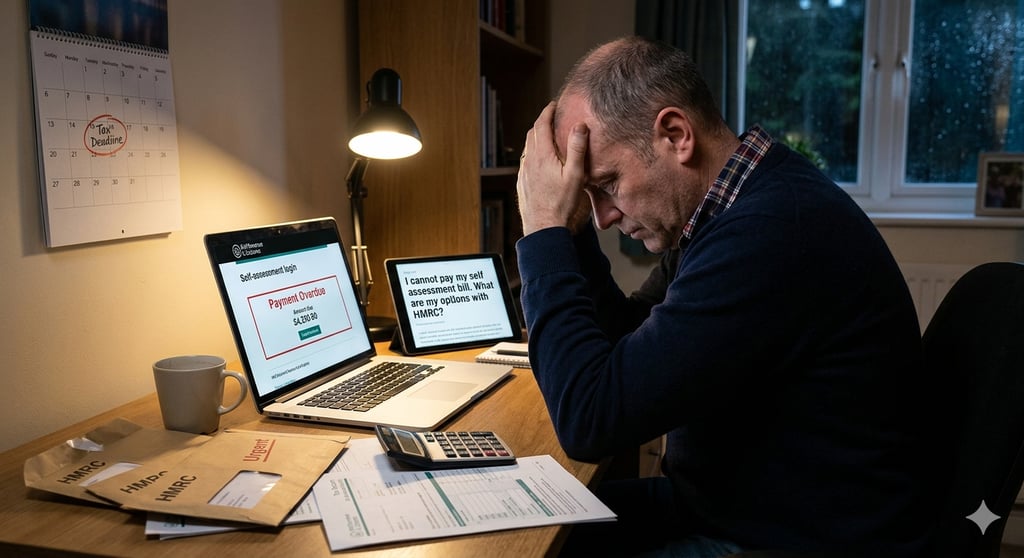
January arrives and the number on the screen is bigger than what is in the account.
It happens to thousands of sole traders every year. Sometimes because the year was harder than expected and the savings were not there. Sometimes because a major client paid late and the cashflow plan fell apart. Sometimes because of illness, a family situation or something else outside your control. Sometimes because the business had a genuinely good year and the tax bill is simply higher than you set aside for.
Whatever the reason, the situation is the same. The bill is due, the money is not there and the question is what to do next.
The answer is more manageable than most people assume. but it requires action, not avoidance. Every day of delay makes the situation more expensive. Everything below is in order of priority. Start at the top.
The Most Important Thing You Can Do Right Now.
File your return if you have not already done so.
This is not optional and it is not secondary to the payment problem. Late filing penalties and late payment penalties are two completely separate systems running simultaneously. Filing your return stops the filing penalty clock immediately, even if you cannot pay a single penny of what you owe.
The filing penalties are the ones that escalate most aggressively. £100 on day one. £10 per day from three months. A further surcharge at six months and twelve months. These are avoidable entirely by filing on time, regardless of whether payment follows.
The late payment penalties will still run on any unpaid balance. But you stop the filing escalation the moment you submit. If you have not filed yet, do it today before you do anything else.
Pay Whatever You Can Right Now.
Once your return is filed, pay as much as you can immediately, even if it is a fraction of the total.
Late payment interest runs at 7.25 percent per year on the outstanding balance, calculated daily from the payment deadline. Late payment surcharges of 5 percent apply at 30 days, 6 months and 12 months on whatever remains unpaid at those points.
Every pound you pay today reduces the balance on which interest and future surcharges are calculated. A partial payment is not a substitute for the full amount but it is meaningfully better than nothing. It also demonstrates to HMRC that you are engaging with the debt rather than ignoring it.
Pay through your Government Gateway account, the HMRC app, or by bank transfer using your UTR as the reference.
Contact HMRC About Time to Pay Today.
This is the part that matters most, and the part most sole traders do not approach with the right mindset.
Time to Pay is a formal arrangement between you and HMRC that allows you to spread your tax bill over monthly instalments. It is not a concession or a special favour. It is an established HMRC service that exists precisely for situations where tax is owed but cannot be paid in a single lump sum.
For bills of up to £30,000, a Time to Pay arrangement can be set up online without needing to contact HMRC directly. Log into your Government Gateway account, navigate to your Self Assessment balance, and follow the prompts to set up a payment plan. You will be asked for your income and expenditure details and offered a monthly repayment schedule based on what you can afford.
For bills above £30,000, you need to call the HMRC Self Assessment payment helpline on 0300 200 3822. Have your UTR, your most recent return and a clear summary of your income and outgoings ready before you call. The conversation is more straightforward than most people expect.
What Time to Pay covers.
Your January tax bill in its entirety, including income tax, Class 4 NI, student loan repayments and the payment on account, all forms part of the balance that can be included in the arrangement.
What it does not do.
Stop interest from accruing. Interest continues to run at 7.25 percent per year on the outstanding balance throughout the repayment period. This is a real additional cost but it is significantly lower than most credit card rates and considerably better than the surcharges that accumulate if you simply do nothing.
How long the arrangement typically runs.
For straightforward debts under £10,000, HMRC usually agrees repayment periods of three to twelve months. Larger debts or more complex situations may take longer to agree, but most reasonable requests are accommodated. HMRC's primary objective is to collect the tax owed. Agreeing a realistic repayment plan achieves that. Refusing one does not.
What HMRC Will Ask You.
Whether you set up Time to Pay online or by phone, HMRC will want to understand your financial position. Be prepared to explain the following.
Why you cannot pay in full. A genuine explanation, such as a late-paying client, an unexpectedly large expense, a quieter trading period or a year where the business simply did not perform as expected, lands better than a vague answer. HMRC distinguishes between people who cannot pay and people who will not pay.
Your monthly income and essential outgoings. The repayment schedule is based on what you can genuinely afford, not on what HMRC would ideally receive. Be honest. An arrangement you can actually meet is better than one that sounds impressive and then defaults.
Whether you have any savings or assets. HMRC will ask. If you have accessible savings that could cover part of the debt, they may expect those to be used before agreeing a repayment plan for the remainder.
Do Not Forget the July Payment on Account.
If you cannot pay your January bill in full, the July payment on account is likely to be just as difficult. It needs separate planning.
When you set up Time to Pay for January, ask whether the July payment can be included or whether it will need its own arrangement. The answer depends on your circumstances. Some Time to Pay arrangements roll the upcoming July payment into the existing plan. Others do not. Knowing which applies to you before July arrives is the difference between a smooth continuation and another last-minute crisis.
If the July payment will need its own Time to Pay arrangement, set up the conversation with HMRC well before the deadline. The same online route applies for bills under £30,000. The same phone helpline applies for larger amounts. Contact HMRC before 31 July, not after.
The other option is to apply to reduce your payments on account if you genuinely expect this year's profit to be lower than last year's. This is a separate process from Time to Pay and worth considering if your business has had a difficult year. The application is made through your Self Assessment return or your HMRC online account, and the reduction is straightforward to request. Be aware that if you reduce your payments and your actual income turns out higher than expected, HMRC will charge interest on the shortfall. The reduction needs to be based on a genuine and reasonable estimate.
What Happens If You Do Nothing.
For completeness, here is what the cost looks like if the bill is simply left unpaid with no contact made with HMRC.
On a £5,000 bill left entirely unpaid for twelve months, the additional cost is £2,713. Interest accrues daily plus three rounds of 5 percent surcharges at 30 days, 6 months and 12 months, plus the filing penalties if the return was also late. The original bill of £5,000 becomes nearly £7,713 through inaction alone.
None of that is inevitable. The penalties and surcharges described above assume no action was taken. Time to Pay stops the surcharges escalating once the arrangement is in place. Filing on time stops the filing penalties entirely. Partial payment reduces the balance on which everything else is calculated.
The cost of the problem is directly proportional to how long it is left unaddressed.
If the Debt Goes Back More Than One Year.
If you have unpaid tax from more than one tax year, the situation is more complex but the same principles apply. HMRC can and does agree Time to Pay arrangements that cover multiple years of debt. The conversation is more involved and the repayment period may be longer, but it is still the right route.
If you have significant arrears across multiple years, consider getting professional advice before contacting HMRC. Understanding your full position, including total debt, penalties and interest already accrued, and your realistic monthly repayment capacity, before you make contact allows you to present a clear and credible proposal rather than a vague one. That produces a better outcome.
After the Arrangement Is in Place.
Once Time to Pay is agreed, meet every payment on time without exception. Missing a scheduled payment under a Time to Pay arrangement cancels it. HMRC then treats the full outstanding balance as immediately due and the favourable terms are lost.
Set up a standing order for the monthly amount on the day you agree the arrangement. Do not rely on remembering to make the transfer manually. One missed payment because of a busy week can undo months of good progress.
The Bigger Picture.
If January is a crisis this year, the priority is resolving it using the steps above. The Time to Pay route is established, accessible and often more accommodating than people expect. HMRC is not your enemy in this situation. They want the tax collected and they have a structured process for situations where it cannot be collected in one payment. Use it.
The longer-term question is how to make next January easier. For most sole traders the answer is not about understanding the tax system better. It is about cashflow management. Knowing your tax position throughout the year. Saving the right percentage each month into a separate account. Being aware when a particularly profitable year means a higher bill is coming.
The UK Sole Trader Tax Template calculates your complete January position, covering income tax, Class 4 NI, student loan repayment and payment on account, automatically from your records throughout the year. You know your number from April onwards. You save against it each month. January is a transfer, not a crisis. And our blog on How to set up a Simple Sole Trader Bookkeeping System will give you all the information you need to help you prepare ahead of time so this does not happenag again.
Get the UK Sole Trader Tax Template, £9.99 →
If you want help working through your specific position, deciding whether to apply to reduce your payments on account, or planning how to approach HMRC for Time to Pay, a Done With You session will take you through it step by step.
Book a Done With You session →
Blog content is for information purposes only and over time may become outdated as the tax landscape is constantly changing, although we do strive to keep it current and up to date. It is written to help you understand your taxes and is not to be relied upon as professional accounting, tax and legal advice. For additional help please contact a professional adviser.
Bookkeeping
Email:
Contact Us
support@rhodiumaccounting.co.uk
© 2026. All rights reserved | Privacy Policy | Terms and Conditions
Monthly Management Reporting
Budgets & Forecasts
Cash flow Optimisation
Processes and Controls
Other Services

