
How to Set Up a Simple Sole Trader Bookkeeping System in the UK Without Expensive Software
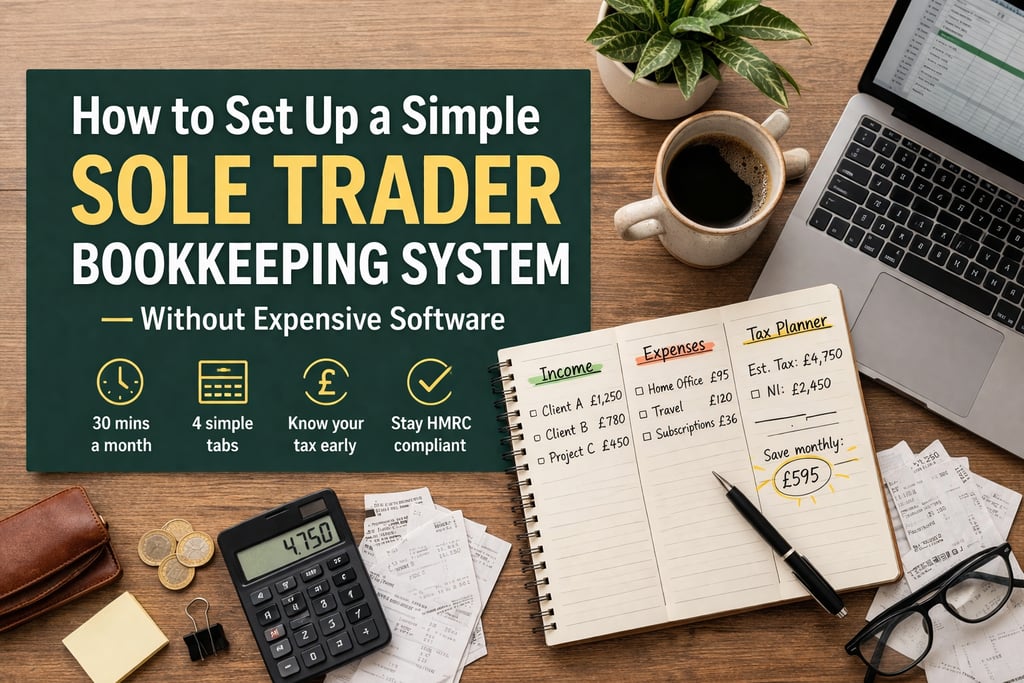
A simple bookkeeping system for a UK Sole Trader does not need expensive software. Four tabs & one powerful decision will make make January a breeze. This post gives you the systemt & the records HMRC requires.
BOOKKEEPING
Bookkeeping feels like the part of running a business that exists purely to cause anxiety. It sits in the background, quietly accumulating, until January arrives and suddenly you are reconstructing twelve months of financial activity from a pile of bank statements, a folder of receipts you may or may not have kept, and a vague memory of what you charged that client in March.
That January experience is not inevitable. It is the direct result of not having a system.
The system does not need to be complicated, expensive or time-consuming to work. This post gives you everything you need to build one today.
The Myth That Expensive Software Solves Your Bookkeeping Problem
The bookkeeping software industry has done an excellent job of convincing UK sole traders that the solution to financial chaos is a subscription to the right platform. QuickBooks. Xero. FreeAgent. All of them have slick interfaces, automatic bank feeds and features that feel compelling in a demo.
Here is the truth most sole trader bookkeeping guides do not tell you.
Software does not create the habit of keeping records. You do.
A sole trader with no system who buys accounting software ends up with an expensive, unused subscription and the same January chaos as before. A sole trader with a simple, consistent manual system ends up with clean records, accurate tax calculations and a January that feels manageable.
The software question is a distraction from the real question: do you have a system you will actually use?
Build the habit first
The software, if you ever need it, slots in easily once the habit exists
Going the other way almost never works
In simple terms: the tool does not matter. The habit does.
What a UK Sole Trader Bookkeeping System Actually Needs to Do
Strip away everything and a bookkeeping system for a UK sole trader needs to do four things.
Record every pound that comes in
Record every legitimate business expense that goes out
Calculate what you owe in tax so January is never a surprise
Produce a record that protects you if HMRC ever asks questions
That is it. Everything else is noise for a business at your level.
The insight worth remembering: most sole traders do not have a bookkeeping problem. They have a consistency problem. The system is simple. The habit is the hard part.
The System: Four Tabs and Thirty Minutes a Month
The entire sole trader bookkeeping system lives in a single spreadsheet with four tabs. You can build this yourself in Excel or Google Sheets in about an hour. Or download our free UK Sole Trader Tax Template and it is already built for you.
Tab 1: Income Tracker Record Every Payment Correctly
Every time you receive a payment, record four things.
Date received
Client or source
Amount
Brief description
Four fields. Thirty seconds per transaction.
One critical point most UK bookkeeping guides miss: record the date you received the money, not the date you raised the invoice. Sole traders are taxed on a receipts basis, meaning the tax year the money arrived in is what matters for your Self Assessment tax return. Getting these dates confused is one of the most common errors on a UK tax return and entirely avoidable with a disciplined recording habit.
Tab 2: Expense Tracker Protect Yourself With Consistent Categories
Every time you spend money on the business, record five things.
Date
Description
Amount
Category
Receipt stored — yes or no
The category column is more important than it looks.
HMRC compares your expense categories against industry benchmarks for your type of business during compliance checks. Inconsistent categorisation — where the same type of expense appears under three different labels across the year — makes your records look unreliable and can trigger closer scrutiny.
Decide on your categories before you start and never deviate. The eight core categories that cover most UK sole traders:
Home office
Mobile phone
Vehicle and travel
Training and development
Equipment and technology
Professional subscriptions
Subsistence
Client-related costs
In simple terms: the category column is not just for your benefit. It is your first line of defence if HMRC ever reviews your records.
On receipts: photograph them immediately on your phone before they fade, get lost or end up in the bin. A digital photo stored in a named folder is perfectly acceptable to HMRC. The habit of photographing receipts at the point of purchase is one of the simplest and most protective things a UK sole trader can do. Pair this with our guidance on allowable expenses for sole traders to make sure you are claiming everything you are entitled to.
Tab 3: Tax Planner - Know Your January Bill Before It Arrives
This is the tab that removes January surprises.
It takes your monthly profit figures and calculates your estimated tax and National Insurance liability using current 2026/27 rates. It also flags your payment on account if your bill is likely to exceed £1,000.
The most important number in the entire system lives here.
Not your income. Not your expenses. Not even your profit. The total amount that will leave your account in January including any payment on account divided by the months remaining until the deadline.
The insight worth sharing: most sole traders who struggle in January are not struggling because they earn too little. They are struggling because they saved toward the wrong number. They saved for their tax bill and forgot about the payment on account sitting on top of it.
For a deeper look at how UK sole trader tax is calculated and how to legally reduce what you owe, see our guide to how to save tax as a sole trader in the UK.
Tab 4: Monthly Summary — Turn Records Into Business Intelligence
At a glance, every month, you see:
Total income
Total expenses
Profit
Effective tax rate
Whether savings are on track against your January target
But the Monthly Summary becomes most valuable over time.
After three months you can see whether income is growing or declining. After six months you can spot expense categories creeping upward without reason. After twelve months you have a complete picture of your business that most sole traders never build because they are too busy reacting to individual transactions to look at the pattern.
Two minutes of honest attention to your Monthly Summary every month is worth more than any amount of sophisticated software.
The Monthly Routine: Five Steps, Thirty Minutes
A word on timing before the steps.
The monthly routine is the floor, not the ceiling.
If you prefer to record transactions as they happen, that is better. Many sole traders photograph receipts immediately and log income the day it arrives. If that comes naturally, keep it. The monthly routine then becomes a five-minute check rather than a thirty-minute catch-up.
If real-time recording feels unrealistic alongside a busy working life, the monthly routine is your system. One missed month becomes two, two becomes six, and six months of unrecorded transactions is where the January crisis begins.
Either approach works. The worst approach is neither.
Step 1: Open your bank statements. Download your business bank account transactions for the month. No separate business account? This step alone is the argument for opening one. It turns twenty minutes into five.
Step 2: Record every income entry. Enter every business receipt into the Income Tracker. Date, source, amount, description. Record what actually arrived, no guessing.
Step 3: Record every expense entry. Enter every legitimate business expense into the Expense Tracker. For anything not yet photographed, do it now while the bank statement is in front of you.
Step 4: Update the Tax Planner. Update your estimated annual profit. The Tax Planner recalculates your January figure automatically. If profit is running higher than expected, increase this month's transfer to your tax savings account.
Step 5: Review the Monthly Summary. Two minutes. Is income where expected? Are expenses reasonable? Anything unusual? Not an audit a sense check that catches problems while they are small.
Five steps. Thirty minutes. Once a month. That is the entire system.
The Small but Powerful Decision That Makes Everything Else Easier
Open a separate bank account for your tax savings today.
Not a savings pot within your main banking app. A separate account at a different bank, where the slight friction of logging in separately acts as a natural barrier against spending it.
Every month, transfer that month's tax savings into this account before you do anything else with the money. First transfer, not last.
The sole traders who consistently meet their January bills without stress share one habit: the tax money is in a separate place. It does not feel available to spend. When January arrives it is a transfer, not a crisis.
One small but powerful decision, made once. Prevents the most common sole trader financial emergency there is.
UK Bookkeeping Records: What HMRC Actually Requires
There is a lot of misinformation about this. Here is what the law actually says.
You must keep records of all business income and expenses for at least five years after the 31 January filing deadline for the relevant tax year. For 2026/27 that means keeping records until at least 31 January 2033.
What counts as an acceptable record:
A photo of a receipt on your phone ✓
A PDF of an invoice in a named folder ✓
A downloaded bank statement ✓
Paper originals are not required ✓
What HMRC requires: records that are readable, organised and available if requested. A folder of several hundred unnamed receipt photos with no context is technically a record. It is not an organised one. A folder structured by tax year and month, with receipts named by date and supplier, takes marginally more effort and is vastly more useful.
The four-year amendment window: if you realise you have underclaimed expenses in a previous year, you can amend that return for up to four years after the end of the relevant tax year. Good records make this possible. No records make it impossible. This is not just compliance. It is keeping open the option to recover money you are legitimately owed. See our guide on small business tax in the UK for more on how to use this window effectively.
The Bookkeeping Mistake That Costs More Than Any Other
The most expensive bookkeeping mistake a UK sole trader makes is not missing a receipt or miscategorising an expense.
It is leaving the bookkeeping for months at a time and then trying to catch up.
Every week that passes makes reconstruction harder:
Receipts fade or disappear
Memory of what a payment was for becomes unreliable
Bank statements require more cross-referencing
Small errors compound
The psychological weight of a growing backlog makes the task easier to avoid
The sole traders who dread bookkeeping are almost always the ones who do it infrequently. The ones who do it monthly find it unremarkable.
A thirty-minute monthly task never becomes a two-day January project. Consistency beats perfection every single time.
Sole Trader Bookkeeping and Making Tax Digital
From April 2026, sole traders with income above £50,000 must keep digital records and submit quarterly updates to HMRC through MTD-compatible software.
The system in this post is the foundation that makes MTD compliance straightforward. The income and expense records maintained monthly become the source data for quarterly submissions. The habit is identical. The output simply goes to HMRC four times a year rather than once.
The threshold drops to £30,000 in April 2027 and £20,000 in April 2028. Most UK sole traders will be inside MTD within two years. Build the habit now, before the deadline forces it.
If you don't already have a separate business account for your business article on the 7 Reasons on why you should have a separate business account will help you decide
The habit comes first. The software comes second. The January crisis never comes at all.
Simple Takeaway
Download the Free UK Sole Trader Bookkeeping Template
Stop reading about the system and start using it.
Our free UK Sole Trader Tax Template includes all four tabs described in this post, pre-built with the correct formulas, category dropdowns and Tax Planner calculations built around confirmed 2026/27 rates.
Download it free. Open it today. Run your first monthly routine this week.
The template is free. The habit it builds is worth considerably more.
Download the Sole Trader Bookkeeping Template →
Looking for more ways to legally reduce your tax bill as a UK sole trader? Read our guide to how to save tax as a sole trader in the UK. For the full picture on running your finances as a sole trader including the incorporation decision, Making Tax Digital and the expenses most sole traders miss see our guide on How to save tax as a sole trader in the UK.
Blog content is for information purposes only and over time may become outdated as the tax landscape is constantly changing, although we do strive to keep it current and up to date. It is written to help you understand your taxes and is not to be relied upon as professional accounting, tax and legal advice. For additional help please contact a professional adviser.
Bookkeeping
Email:
Contact Us
support@rhodiumaccounting.co.uk
© 2026. All rights reserved | Privacy Policy | Terms and Conditions
Monthly Management Reporting
Budgets & Forecasts
Cash flow Optimisation
Processes and Controls
Other Services

