How to Claim Home Office Expenses as a UK Sole Trader
Two methods, real numbers, and the mistakes to avoid. A focused guide to claiming home office expenses as a UK sole trader in 2026/27, with worked examples for both the flat rate and actual cost methods.
SELF ASSESSMENT TAX RETURNS
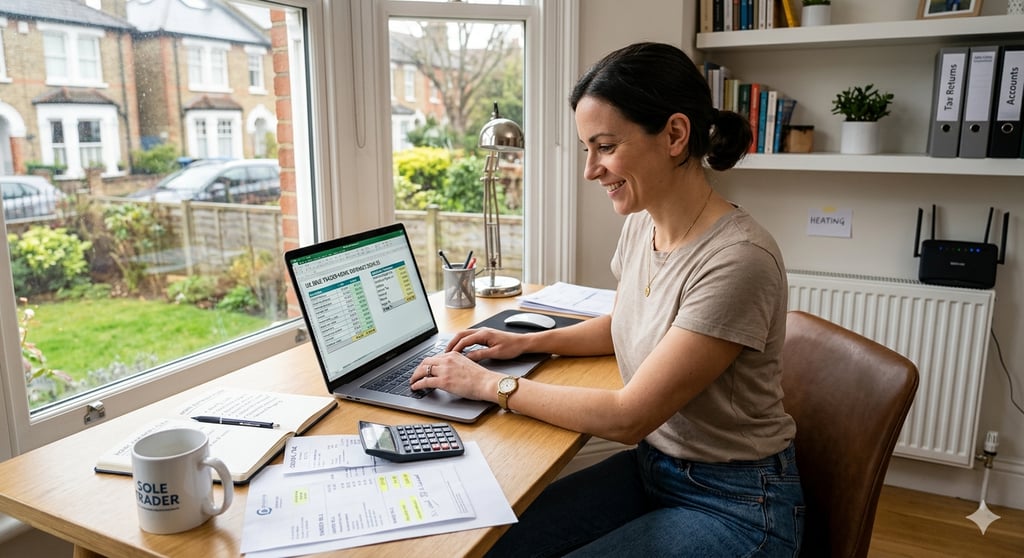
If you do any regular business work from home as a sole trader, you can claim a share of your household costs as a business expense. This is one of the most commonly missed claims in UK sole trading, with most home-based sole traders either not claiming anything at all or claiming the wrong amount because they do not know which method applies to them.
There are two methods HMRC accepts, the simplified flat rate and the actual cost method. This post walks through both, including which one suits which type of home worker, what each one is worth in real money, and the common mistakes to avoid.
What Counts as Business Use of Home
You can claim home office expenses if you do any genuine business administration from home. This includes invoicing, quoting, record-keeping, replying to client emails, scheduling work, preparing reports or design work, and any other activity that contributes to running your business. The work does not have to be your main activity, and you do not have to work from home full-time.
The minimum threshold for the simplified flat rate is 25 hours of business use per month. The actual cost method has no minimum hour threshold but requires you to use a specific room exclusively for business.
The Simplified Flat Rate
This is the easier method and suits most part-time and occasional home workers. HMRC publishes a fixed monthly rate based on the number of hours you work from home each month.
For 25 to 50 hours of home working per month, you claim £10 per month or £120 per year. For 51 to 100 hours, you claim £18 per month or £216 per year. For 101 hours or more, you claim £26 per month or £312 per year.
The flat rate covers household running costs only, which means gas, electricity and water. HMRC's own guidance at BIM75010 confirms that using the flat rate does not prevent you from claiming other home-related costs separately on top of it.
What you can claim on top of the flat rate, even without a dedicated business room, is a business-use proportion of council tax, telephone, broadband, and buildings or contents insurance. These are calculated based on the share of your home used for business and the hours you use it for business, in the same way as any other apportionment.
What you cannot claim on top of the flat rate if your room is used for both business and personal purposes is rent or mortgage interest. HMRC's guidance at BIM47820 is explicit that rent and mortgage interest are only allowable when "part of the home is used solely for the trade". A mixed-use room does not meet this test. If you want to claim rent or mortgage interest, you need either a dedicated business room or to switch to the full actual cost method.
A worked example
A sole trader works from home 60 hours a month in a typical three-bedroom UK house with one living room. One of the bedrooms is used for business work but also as a guest bedroom occasionally, so the room is mixed-use. The actual cost method does not apply to the room.
The sole trader claims the simplified flat rate of £18 per month, which is £216 per year. On top of that, they apportion their telephone, broadband and council tax based on business use.
Broadband at £40 per month with an estimated 40% business use is £192 per year.
Mobile phone at £30 per month with 50% business use is £180 per year.
Council tax at £180 per month, apportioned by the share of rooms and hours used for business, is around £130 per year.
The total annual claim is £216 plus £192 plus £180 plus £130, which is £718 per year. At basic rate income tax plus Class 4 NI, that saves £187 in tax. At higher rate, it saves £301. This is significantly more than the £216 flat rate alone, and is what HMRC genuinely allows for a sole trader with a mixed-use home office.
Our guide to saving for your sole trader tax bill covers how to factor expense savings like this into your monthly set-aside so the smaller tax bill is reflected in what you save.
The Actual Cost Method
The actual cost method allows you to apportion the real costs of running your home and claim the business proportion of all your household costs, including rent or mortgage interest. This includes utilities, council tax, water, broadband, contents insurance, and rent or mortgage interest on the business-use portion of the property.
The method only applies to a room used exclusively for business. A dedicated home office, a converted garage, a garden studio. The room must have no personal use during the period it is set up for business. If the room doubles as a bedroom, a dining room, or any other personal-use space, the actual cost method does not apply and the simplified flat rate is the right method instead.
A worked example
A sole trader rents a typical three-bedroom UK house at £1,400 per month and uses one bedroom exclusively as a dedicated office. The rooms that count for the apportionment are the three bedrooms plus the living room, giving four rooms in total. Kitchens, bathrooms and hallways are excluded because they are not considered living rooms for this purpose. The business room is one quarter of the total, which is 25%. The claim on the rent is £1,400 multiplied by 25% multiplied by 12 months, which is £4,200 per year.
Add a similar apportionment for council tax, utilities and broadband, and the total annual claim can easily reach £5,000 to £7,000 per year for a sole trader genuinely using a dedicated room. At basic rate that saves £1,300 to £1,820 in tax. At higher rate it saves £2,100 to £2,940.
The trade-off is significantly more record-keeping. You need to keep evidence of the actual costs, the apportionment method, and demonstrate that the room is genuinely dedicated to business use. If HMRC asks, you should be able to explain the calculation clearly.
The Decision Matrix
The decision between the two methods comes down to your specific situation. The table below covers the most common scenarios for UK sole traders.
Which Method Is Right for You?
Three quick scenarios to confirm what the table shows.
If you work from home occasionally for admin tasks and your business is mostly conducted elsewhere, the simplified flat rate plus separately apportioned council tax, broadband and phone is the right choice. The total claim is meaningful and the admin requirement is manageable.
If you work from home regularly using a dedicated room with no personal use, the actual cost method usually produces a larger claim because it allows you to claim rent or mortgage interest in addition to all the other apportioned costs. The trade-off is the additional record-keeping, but for sole traders with a genuine home office the saving is worth it.
If you rent a small flat and work everywhere in it without a dedicated business space, the simplified flat rate plus separate council tax, broadband and phone is the cleanest choice. The actual cost method requires a dedicated room, which most one-bedroom flats do not have.
The Two Mistakes to Avoid
The first is trying to use the actual cost method on a mixed-use room. A bedroom that is also your office does not qualify for the actual cost method, and rent or mortgage interest cannot be claimed even on a proportion. The wholly and exclusively rule applies, and HMRC's guidance is explicit that rent and mortgage interest are allowable only when part of the home is used solely for the trade. The simplified flat rate plus apportioned council tax, broadband and phone is the right approach in this situation.
The second is assuming the simplified flat rate is the only thing you can claim. The flat rate covers utilities only. Council tax, broadband, phone and buildings or contents insurance can all be claimed separately on a business-use proportion on top of the flat rate, even without a dedicated business room. HMRC's own guidance at BIM75010 confirms this is permitted. Claiming the flat rate alone undersells what HMRC genuinely allows.
The Capital Gains Tax Consideration
One thing worth knowing if you use the actual cost method on a property you own. If a room is used exclusively for business, that portion of the property may lose its Principal Private Residence relief when you eventually sell, meaning Capital Gains Tax could apply to the business proportion of any gain. For most home-based sole traders the saving from the actual cost method over a working career significantly outweighs this risk, but it is worth knowing about, particularly if you are considering selling the property soon.
The simplified flat rate avoids this risk entirely because it does not require any room to be exclusively business use.
What to Do Next
Pick the method that fits your situation, set up a simple monthly log of hours or costs depending on which method applies, and add the claim to your Self Assessment return when the time comes. The home office claim is genuinely useful money that most sole traders leave on the table because they assume it is too complicated or they do not realise they qualify.
Home office costs are one of several allowable expenses that significantly reduce your tax bill. Our walk-through of how much tax sole traders pay in 2026/27 covers the bigger picture of where these claims fit into your January position, with an interactive calculator that shows you what your bill looks like before and after claiming expenses like this one.
If you want a system that automatically tracks your home office hours and calculates the right claim, the UK Sole Trader Tax Template includes the simplified flat rate calculation in the expense categories and works alongside the actual cost method if you prefer.
Get the UK Sole Trader Tax Template, £9.99 →
Blog content is for information purposes only and over time may become outdated as the tax landscape is constantly changing, although we do strive to keep it current and up to date. It is written to help you understand your taxes and is not to be relied upon as professional accounting, tax and legal advice. For additional help please contact a professional adviser.
Bookkeeping
Email:
Contact Us
support@rhodiumaccounting.co.uk
© 2026. All rights reserved | Privacy Policy | Terms and Conditions
Monthly Management Reporting
Budgets & Forecasts
Cash flow Optimisation
Processes and Controls
Other Services

