
Can You Claim a Spare Room as a Business Expense UK? A Guide for Online Sellers
Can you claim a spare room as a business expense in the UK? Yes. Online sellers who store stock or pack orders at home can claim rent and bills. Here is how.
RUNNING A BUSINESS
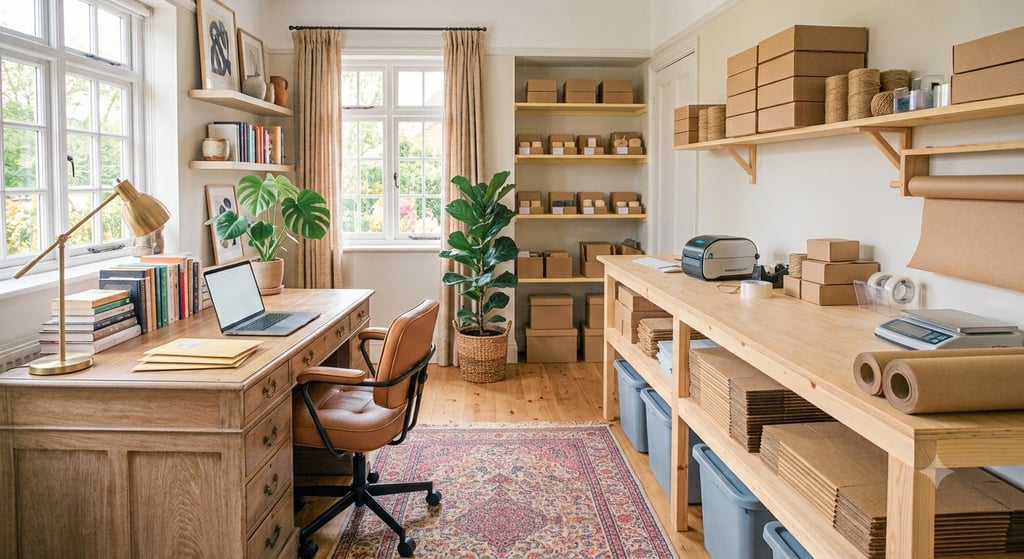
Marcus has been full-time reselling vintage clothing from his Salford flat for two years. One bedroom is essentially a stockroom. Rails of denim jackets, shelves of sorted and photographed pieces waiting to list, a packing table in the corner with a label printer and a roll of bubble wrap permanently attached to the wall. He walks in there every morning to start work and walks out every evening when he is done.
He has never claimed a penny of his rent or utility bills as a business expense. It did not occur to him that he could.
He can. And at his level of selling, the amount he has been leaving unclaimed is likely to be in the hundreds every year.
Why This Is Different from the Standard Home Office Claim
Most posts about claiming home expenses talk about working from home in general terms. This one is specifically about the space you use to store stock and pack orders, which uses a different calculation from the simplified working-from-home flat rate.
The simplified flat rate of £6 to £26 per month is based on hours spent actively working at home. It was designed for people who sit at a desk, work on a laptop, and would otherwise be in an office. It does not adequately capture the situation of someone like Marcus, whose spare room functions as a warehouse, photography studio and dispatch centre. That room is being used for business purposes whether Marcus is standing in it or not. Stock sitting on a shelf is occupying business space whether anyone is in the room or not.
For that kind of use, the correct method is the floor area apportionment, and it tends to produce a more meaningful deduction than the simplified rate for sellers who are running a genuine stock-based business from home. Our home office expenses guide covers the simplified rate approach in full if that is more relevant to your situation.
How the Floor Area Calculation Works
The calculation has three steps.
Step one: Measure the floor area used for business. This is the usable floor area in square metres of the room or space dedicated to storage and packing. If the space is used for mixed purposes, a reasonable estimate of the proportion genuinely occupied by the business is acceptable.
Step two: Divide that by the total floor area of your home to get a percentage. This is your business use proportion.
Step three: Apply that percentage to your total home running costs for the year. The costs that qualify are rent, mortgage interest (not capital repayment if you own), gas and electricity, water rates, council tax and buildings insurance. Broadband qualifies too if you use it for the business, which Marcus certainly does.
Marcus's calculation. His flat is 58 square metres in total. The spare room he uses for stock and packing is 11 square metres. His business use proportion is 11 divided by 58, which is 19 percent. His annual home running costs are:
Rent: £12,600
Gas and electricity: £1,080
Water rates: £240
Council tax: £1,440
Buildings insurance: included in service charge — £180
Broadband: £360 (full cost, as he uses it exclusively for business sourcing, research and selling)
Total annual home running costs: £15,900
Business proportion at 19 percent: £3,021
Marcus has been leaving over £3,000 per year of deductible expenses unclaimed. At the combined basic rate of 26 percent, that is approximately £785 per year in tax and NI he has been overpaying. Across two full years of trading, that is close to £1,500 in avoidable tax.
The Exclusive Use Question
Here is the point almost nobody mentions but that genuinely matters depending on whether you rent or own.
If Marcus owned his flat rather than renting it, using the spare room exclusively for business would create a potential Capital Gains Tax problem when he sold. Private Residence Relief normally makes the entire gain on a house sale exempt from CGT. If a room has been exclusively used for business, that portion technically loses the exemption and a proportion of any gain could be subject to CGT. For homeowners, the practical solution is to maintain some personal use of the room, even occasional, to preserve full Private Residence Relief. The slightly reduced business proportion claim is almost always the better trade-off against a future house sale.
Because Marcus rents, this does not apply to him. He has no capital gain to worry about. He can claim the full floor area proportion of his rent and running costs without any CGT consideration. Renters are actually in a cleaner position on this particular claim than owners.
For those reading this who do own their home: the dual-use approach is almost always the right one. Keep the room available for personal use in some form, claim the proportion that reflects your actual business use, and do not make an exclusive use claim without taking professional advice first on the CGT implications.
Mixed Use: When the Room Also Serves a Personal Purpose
Marcus's situation is relatively clean. The room is his stockroom. It is not also a guest room or a home gym. But a large number of online sellers are in a mixed use situation, the spare room that is also where guests sleep, the dining room table that becomes a packing station three evenings a week, the garage that holds both stock and the family bikes.
Mixed use does not disqualify the claim. It adjusts it. If the space is used for business roughly half the time, apply the floor area proportion at 50 percent. If it is business use roughly a third of the time, apply a third. HMRC does not require a time log for storage space. A reasonable and consistent estimate is acceptable.
The important word is consistent. Pick the proportion that honestly reflects your business use, apply it the same way every year, and note it down alongside the floor area calculation so it is available if HMRC ever asks.
What Counts as a Home Running Cost
The costs you apply the business proportion to are rent or mortgage interest (not the capital repayment element), gas and electricity, water rates, council tax, buildings insurance and broadband to the extent it is used for the business.
Contents insurance is not normally included unless you have specifically arranged cover for business stock. If you have separate insurance for your stock, that is a direct business expense and claimable in full rather than as a proportion of home costs.
How This Interacts With Marcus's Overall Expenses Position
This is where the numbers become genuinely significant. Marcus's combined actual expenses for 2025/26 look like this once the spare room is included:
Stock purchased: £7,400
Mileage at 55p per mile (4,800 miles): £2,640
Packaging materials: £340
Mobile phone (business proportion 70%): £252
Subscriptions and selling tools: £180
Spare room home costs: £3,021
Total actual expenses: £13,833
Against his gross income of £22,800, his taxable trading profit under actual expenses is £8,967. The £1,000 trading allowance would have left him with £21,800 of taxable income. The difference is £12,833, which at 26 percent saves Marcus approximately £3,337 in tax and NI compared to claiming the allowance.
This is why the decision between the trading allowance and actual expenses is not academic for a seller at Marcus's level. The spare room claim alone is more than three times the entire flat allowance. Our complete expenses guide for online sellers covers every other deductible cost alongside the home use claim and includes a calculator that shows your combined position.
For sellers whose total expenses are modest, the trading allowance will still win. For sellers sourcing stock regularly, driving significant mileage and using a meaningful proportion of their home for the business, actual expenses is almost certainly the right route. The mileage guide and the packaging and shipping expenses post cover the two other significant categories that combine with the home use claim in most full-time or near-full-time seller situations.
What Records Marcus Needs to Keep
For the home running costs claim, Marcus needs his annual bills or statements for each category. Rent payments from his bank account, gas and electricity statements, his council tax bill, and his broadband account all serve as evidence.
He also needs a note showing the floor area calculation: the area of the business room, the total flat area, the resulting percentage, the annual costs applied to that percentage, and the resulting deduction. Five minutes of documentation that turns an estimate into a defensible claim.
He should keep these records for at least five years after the 31 January filing deadline for each relevant tax year. If he is amending his 2024/25 return to include the spare room claim he missed, he needs to keep the supporting records for that year until at least 31 January 2031.
The UK Online Seller Tax Template has a dedicated home use expense line. Marcus enters his annual figure once and it flows automatically through to the trading allowance versus actual expenses comparison so he can see immediately whether the home use claim tips the balance further in favour of actual expenses. At his level of selling, it emphatically does.
Bookkeeping
Email:
Contact Us
support@rhodiumaccounting.co.uk
Monthly Management Reporting
Budgets & Forecasts
Cash flow Optimisation
Processes and Controls
Other Services

